Is the NHL entering its Trade Era?


Most hockey fans and stakeholders can agree that the salary cap has been good for the sport’s competitive balance. State tax drama aside, teams aren’t winning or losing because of seismic payroll gaps.
But when it comes to player movement? Blockbuster trades have been on life support for most of the last two decades. Sure, we’d get some splashy but predictable deadline rentals (example: Martin St. Louis to the New York Rangers). And draft week historically led to the occasional whopper — P.K. Subban for Shea Weber dropped some jaws. But the rigid cap environment has long been a drain on the thrill of big-time trades.
Until now…
There were more high-profile swaps in four days in late June than there have been in entire NHL seasons. With the 2026 Entry Draft and the opening week of free agency in the rearview mirror, it’s become clear that a number of converging factors are ushering in the dawn of a new era. After 20 years of limited flexibility, is the NHL entering its Trade Era™️?
🔁 Trade History
There was a time where two GMs, probably smoking cigars and certainly not contending with trade destination lists, made franchise-altering deals. Shake-up moves. Players seeking future raises dumped overnight. Superstars for superstars. Five-player swaps. It was a fundamentally different time for player rights — no-movement clauses were scarce, agents had a fraction of today’s bargaining power, and ruthlessness reigned supreme.
Fast forward to the introduction of the salary cap. Front offices have managed an evolving set of exhaustive rules, razor-thin room at the cap ceiling, buyout calculators, escrow (remember that?), LTIR math, a half-season lockout, a pandemic that wrecked the business model for four years and limited knowledge of future cap parameters.
Good luck making meaningful trades. But things have shifted fast on the trade front. From June 19 to July 1 alone, the following notable players were dealt:
- Darren Raddysh
- Brady Tkachuk
- Bowen Byram
- Jordan Kyrou
- William Eklund
- Simon Nemec
- Alex Tuch
- Connor McMichael
- Valeri Nichushkin
- Mason McTavish
- Pavel Dorofeyev
- JJ Peterka
- John Carlson’s rights
- Brandon Carlo
- Radko Gudas’ rights
- Jacob Markstrom
- Marcus Pettersson
- Vincent Trocheck
- Darnell Nurse
- Mavrik Bourque
- Blake Coleman
During the 13-day stretch, a total of 83 players were traded. That’s enough players to ice four complete rosters. There was so much action that NHL insiders risked missing breaking news from stopping to eat.
The trade bender led to a ton of intrigue and eyeballs before the league goes into its summer hibernation. NHL fans have long envied followers of its calendar cousin, the NBA, which famously features frequent, stunning trades of star talent.
Excuse the pun, but what’s the deal with all of these deals?
💰 Factor #1: The salary cap is rising
During the decade from 2013-14 through 2023-24, the salary cap increased by an average of 2.4%. Only twice did the bump exceed 3.5% year over year and both instances were pre-pandemic. With so many franchises spending near the max, finding the mix of dollars and contracts created a frustrating trade landscape. GMs had to be creative by stickhandling around CBA rules or chasing third-party brokers to execute high-profile trades.
But not only has the cap escalated, the multi-year projection issued in early 2025 provides front offices with a road map to know they can spend freely into the future:
- 2025–26: $95.5 million (+8.5%)
- 2026–27: $104.0 million (+8.9%)
- 2027–28: $113.5 million (+9.1%)
The rising cap room has already had an immediate impact on the volume of players traded.
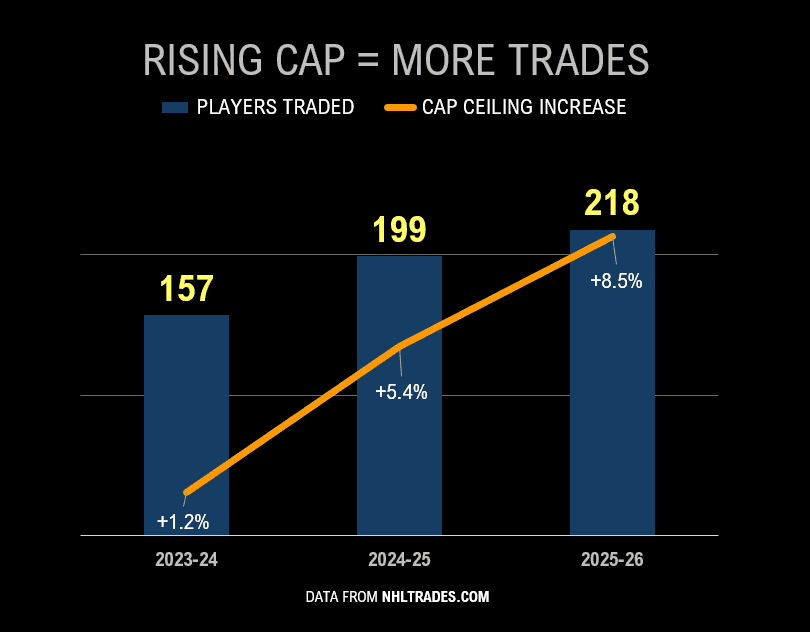
That’s 61 more players dealt this past season versus 2023-24. Nearly a 40% bump. Per NHLTrades.com, that’s the second-highest number of traded players ever in a season (defined as July 1 to June 30). The only season with more players moved was 2022-23 with 238 — which followed three consecutive flat cap seasons during and after the pandemic.
Right now, teams not only have the space to make trades but can do so with the certainty of more space arriving in subsequent seasons. Front offices can plan their futures. What a concept.
📝 Factor #2: Free agency is dying a slow death
There’s more to the trade surge than simply more dollars available in the system, however. The gradual demise of free agency is a key part of the trade trend. Simply put, it’s become very difficult to improve your team without trades.
The Entry Draft adds free talent, sure. But outside of a handful of outstanding teenagers, nearly every prospect is drafted years away from earning meaningful minutes atop an NHL lineup. It’s a slow burn.
The third option, free agency, has long been a necessary evil to add talent — even if it’s overpriced and shortsighted. But teams are extending stars early, often, and long-term, preventing impact players from reaching unrestricted free agency in their primes. This year’s biggest UFA contracts by total dollars went to: Rasmus Andersson ($59.5 million); Mason Marchment ($33.75 million); Jacob Trouba ($33 million); Boone Jenner ($23 million); and 37-year-old Sergei Bobrovksy ($21 million). Yikes. Jeffrey Viel, a 29-year-old journeyman forward with 15 career NHL points, signed the 10th biggest contract ($12.5 million over five years) in the first two days of July’s free agency blitz.
Let’s just say that the players reaching free agency weren’t keeping their former GMs up at night. This year’s crop leaned heavily toward veterans long past their peaks signed at uncomfortable prices. The 27-year-old version of John Tavares from 2018 could have asked for ownership in Maple Leafs Sports & Entertainment in this climate.
🧳 Factor #3: Players are forcing trades
While Quinn Hughes, Dylan Larkin, and Brady Tkachuk engineering their exits from the teams that drafted them could be dismissed as circumstantial, it has undoubtedly had a ripple effect. Shortly thereafter, rumored Zach Werenski trades went wild. Connor Hellebuyck’s future has also become a hot topic. A Hughes’ brother reunion has long been considered likely.
Is this a perfect storm of Team USA teammates in stalled northern markets pursuing Stanley Cup dreams elsewhere? Or a mass movement of players, armed with negotiated trade protection, calling their shots to selected destinations?
The answer remains unclear. Now, Larkin, Werenski, and Hellebuyck have not been traded. Neither has their Gold medal-winning captain Auston Matthews. Cooler, or at least calmer, heads may yet prevail.
But what is clear is that teams, saddled by so many recklessly issued no-movement clauses or restricted lists, have lost considerable control in the power battle with the players. In the cap era, players have historically been loyal to their drafted teams. They have signed extensions early and frequently on discounted deals, rode the highs and lows of escrow and flat caps and rarely forced their GMs’ hands. So, there’s an argument — one made by player agents — that a reckoning is long overdue. But when A.J. Greer, who has averaged 9:47 per night over his career, negotiates trade protection with Anaheim, tough questions on the balance of power are inevitable.
It’s also fascinating to watch the ripple effect of a superstar being dealt. Quinn Hughes’ exit from Vancouver triggered a teardown. His arrival in Minnesota escalated a win-now window. Clearing room for Brady Tkachuk led to a chaotic few weeks for Florida. Ottawa responded to his departure by acquiring Eklund from San Jose, the Senators’ plans quickly altered. Foundational player deals have a domino effect that leads to more trades, signings, and aggressiveness, further shifting the NHL’s competitive landscape.
✈️ Has the Trade Era Arrived?
There’s no question the factors are in place for a multi-year run that brings the NHL’s trade cauldron to a boil.
A rising salary cap ignited the trend. The slim pickings of free agency effectively forces trades. Players taking control of their destinies continue to kickstart an avalanche of related activity. Collectively, these elements are creating a dynamic culture among GMs, where high-risk moves and seizing the moment are a requirement in the fight to acquire talent. The Leo Carlsson offer sheet and Chicago‘s acquisition of Byram epitomize a renewed energy for disruption. General managers know how hard it is to land premium players and they’re willing to take risks seldom seen in the last 20 years.
While we’ll need more in-season trades to officially label this the NHL’s Trade Era, the stage is set for more Shakespearean drama ahead. The possibilities alone are all part of the chaos and fun.
Recently by Paul Pidutti
- Day-after reaction: Hockey Hall of Fame’s Class of 2026 (mostly) gets it right
- Projecting the 2026 Hall of Fame Class: Bergeron, Price, Räty and endless possibilities
- Who makes the Hockey Hall of Fame All-Snub Team?
- Spoiler alert: Goaltending decides the NHL playoffs
- What can the modern history of No. 1 picks tell us about Toronto’s future?
_____
POST SPONSORED BY bet365
_____