What can the modern history of No. 1 picks tell us about Toronto’s future?

You may have heard that the Toronto Maple Leafs won the No. 1 pick in the 2026 NHL Entry Draft.
Rigged! Of course they did! They still won’t ever win a Stanley Cup! What a joke!
Now that the mandatory rage, conspiracy theories and cheap shots are out of the way, let’s talk first overall picks. We know that choosing in the top draft slot can help relaunch a franchise. Sidney Crosby, Nathan MacKinnon, Connor McDavid, and many others are living proof. Just this past season, Matthew Schaefer resurrected the New York Islanders‘ hopes overnight.
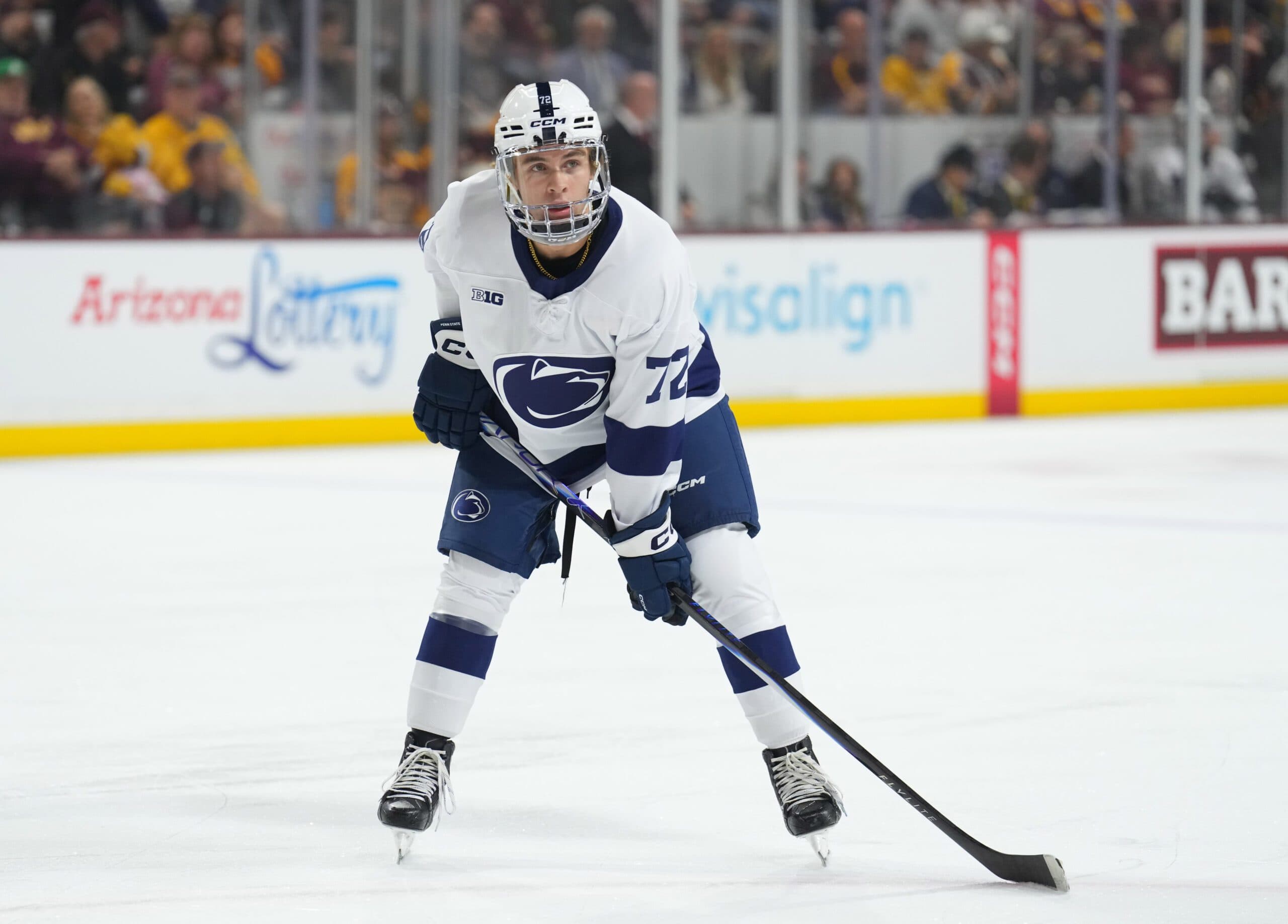
Gavin McKenna, widely considered the draft’s best prospect, is available for new Leafs’ general manager John Chayka to select in June. But what kind of performance should we expect from the No. 1 pick? How fast do first overall picks make real differences? And can a talented 18-year-old be impactful enough to bring Toronto off the mat and back to contending?
✈️ Welcome to the NHL
Whether it’s McKenna or Ivar Stenberg, a forward is highly likely to be selected first, meaning forwards will be our focus today. Five defensemen have been taken No. 1 in the cap era — Erik Johnson (2006), Aaron Ekblad (2014), Rasmus Dahlin (2018), Owen Power (2021), and Schaefer (2025). But the development arc of teenage blueliners is typically so much slower that there’s little basis for comparison across positions.
In the salary-cap era, there have been 21 NHL Entry Drafts. In 16 of those drafts, the first overall pick was a forward. What kind of point production have No. 1 forwards generated in their first five NHL seasons? Here’s the wide range of results.
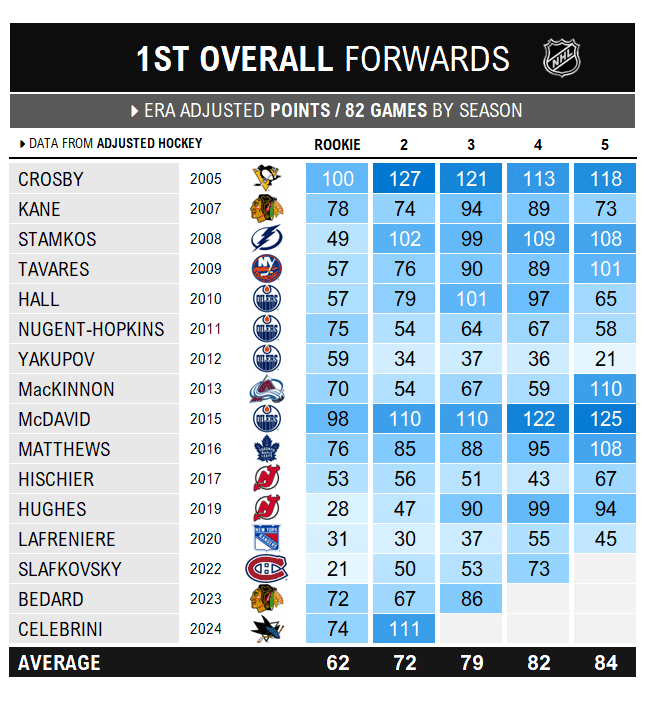
To put two decades of players on a level playing field, the point rates above are: (i) era adjusted to a neutral scoring climate; and (ii) projected over 82 games.
After going first overall, the average forward arrives a 62-point player. That’s an impressive output for a teenager. For context, this is a similar point rate to Ivan Demidov (the No. 5 pick in the 2024 draft) as a 20-year-old this season.
For today’s purposes, we’ll assume the Leafs don’t overthink this pick and select McKenna. While he’s rightfully a well-hyped prospect — 2.30 points-per-game in the WHL as a 17-year-old will do that — McKenna’s still mid-range among the exceptional group of No. 1 picks in the last two decades.
Each of Crosby (era adjusted 100-point rookie pace), McDavid (98), Patrick Kane (78), Auston Matthews (76), Macklin Celebrini (74), Connor Bedard (72), MacKinnon (70), John Tavares (57), and Steven Stamkos (49) ranged from comparable to far greater draft chops. And despite tough NHL rookie seasons, let’s not forget how exciting Jack Hughes (28) and Alexis Lafreniere (31) were as prospects.
A 62-point rookie season — average among No. 1 forwards — would be a successful debut for McKenna. The group’s average pace rises to 72 points as sophomores, reaching point-per-game status by Season Four. Of the 16 forwards, 10 authored at least one adjusted 90-point pace in their first five NHL seasons. Bedard and Juraj Slafkovsky could make that a dozen. With a few exceptions, it’s a high-floor, high-ceiling slot.
🔨 Adding Value
Points are a great start. Adapting to the NHL as a teen by consistently getting on the scoresheet is a critical step toward franchise player status. But points are a blunt instrument in terms of a player’s overall contributions to a team’s success.
For those unfamiliar with WAR — Wins Above Replacement — it’s an all-encompassing figure that measures a player’s value above a replacement player. In other words, it’s how many wins a player adds to a team compared to an AHL call-up or waiver wire pickup. WAR is so effective because it does what raw point totals cannot — it factors in defensive contributions, teammates, competition, and usage.
Teams that pick first in the draft need a lot of help to move up the standings. Summarized in the graphic below are the number of wins our No. 1 overall forwards added by season via HockeyStats.com’s WAR model. All figures are rounded and pro-rated over 82 games to keep things clean and simple.
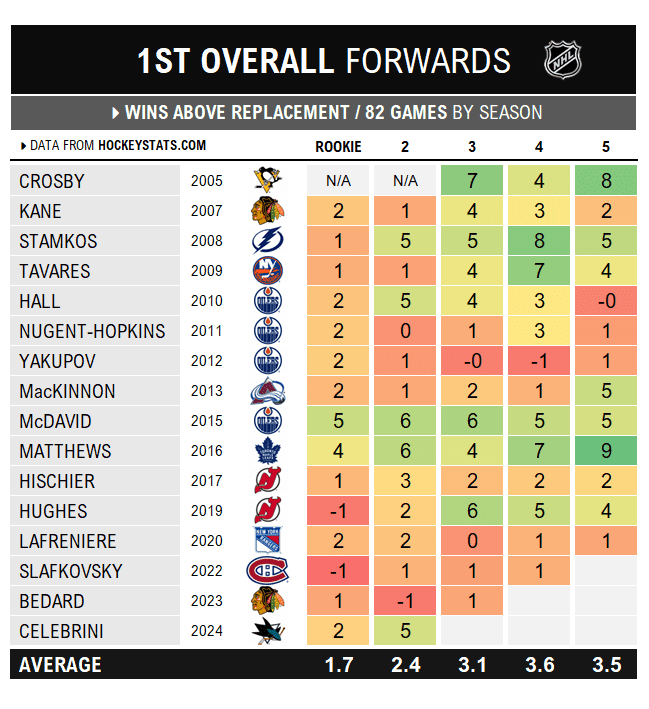
There’s a reason teams that win the draft lottery don’t quickly become contenders. Forwards chosen first overall have averaged 1.7 wins (or three to four standings points) per 82 games as a rookie. That’s great value for a junior-aged player on what’s typically a terrible team, but in isolation it’s only a baby step toward Stanley Cup contention.
While most No. 1 picks were able to bank points early in their careers, many didn’t add much value due to some combination of defensive shortcomings and inability to drive play. Each of Kane, Tavares, Ryan Nugent-Hopkins, Nail Yakupov, MacKinnon, Hughes, Lafreniere, Slafkovsky, and Bedard never topped a two-win season as rookies or sophomores. It can be a slow burn to make a real impact.
The very best No. 1 picks can add value fast, though. Each of McDavid, Matthews, Stamkos, Celebrini, and Taylor Hall played at a five-plus win rate as a sophomore. While Crosby’s second season precedes modern analytics, it’s safe to assume his 2006-07 Hart Trophy year was also at that high level.
If Leafs Nation assumes McKenna will singlehandedly spark the blue-and-white 10 points in the standings, it’s not realistic. For 2026-27, anyway. Only McDavid — and possibly Crosby if the data existed — added that kind of on-ice value alone as a rookie. Those were the two most unparalleled junior talents of the last 35 years. For McKenna, adding about two wins of value as a rookie is a reasonable target.
🥊 Can the Leafs Rebound?
The good news for Maple Leafs fans?
Toronto isn’t starting from the basement on its quest for the penthouse. Outside of the New York Rangers (2019-2020) and New York Islanders (2024-25), this past season’s Leafs had a higher points percentage than every other team that has selected No. 1 in the cap era.
Here are the results of each franchise before and after drafting a forward first overall, ranked by points gained in the standings after two seasons.
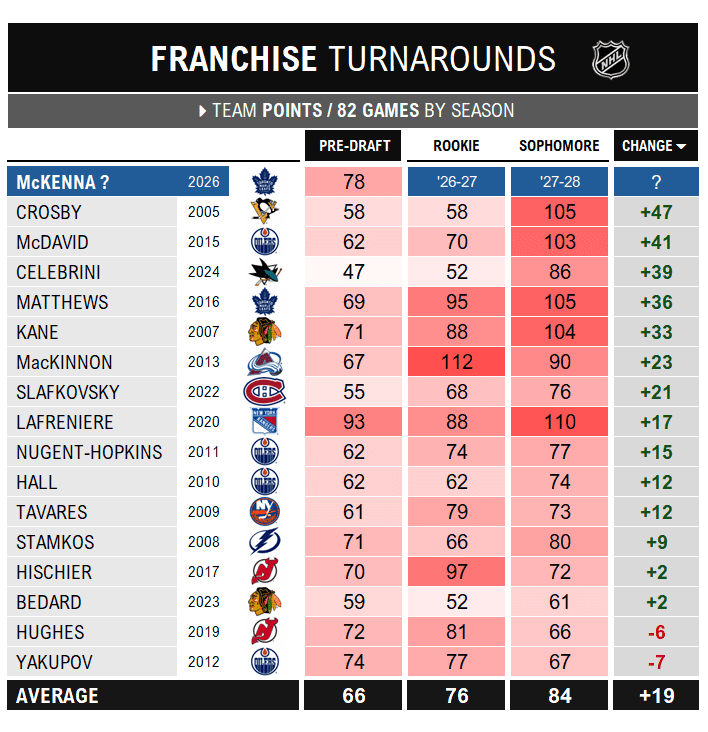
After selecting a forward first overall, the average franchise shot up 10 points in the standings in Year 1 and another eight in Year 2.
Of course, it’s much easier to gain 20 points when you’re a 50 or 60-point team. Those franchises usually have a lot of flexibility and few bad contracts. Most teams picking No. 1 had already pooled prospects on their freefall to the league’s cellar. That’s not the Leafs right now.
Chicago had No. 3 pick Jonathan Toews to pair with Kane. Pittsburgh had drafted Marc-Andre Fleury (No. 1) and Evgeni Malkin (No. 2) before Crosby. Edmonton was winning draft lotteries in their sleep in the 2010s.
An optimistic fan, however, would say that on paper last year’s Buds were more like the 100-point teams of the last decade than a 78-point team wrecked by injuries, dysfunction, and the ghost of Mitch Marner. The Leafs’ faithful believe good health, recoveries from Matthews and William Nylander, a blueline shuffle, the No. 1 pick effect, and a potential coaching shakeup add the requisite 17 or 20 points for a playoff return.
But that’s a lot of things working out after a season where nothing did.
All their core players are one year older and in several cases coming off major injuries (Matthews, Chris Tanev, Anthony Stolarz, Brandon Carlo). Other than Matthew Knies and Easton Cowan, 24 and 21 respectively next season, Toronto’s cupboard is bare. This means their rebound will depend on glow-ups from existing players mostly past their primes versus meaningful internal development.
Are the Leafs a skilled teenager from winning the Stanley Cup?
No, of course not. But adding McKenna should deliver many positives. At a minimum, they’ll add a very high upside player that should help right away. McKenna could be the dynamic winger that Matthews sorely needs to restore the captain’s faith in the franchise. Some good vibes may turn down the temperature on a front office already under fire. McKenna also offers a parachute into a future rebuild if Toronto can’t recover in 2026-27 and needs to start over in a post-Auston apocalypse.
💭 Closing Thoughts
Much can and will happen before opening night in October. In the last 102 days:
- McKenna faced a felony charge for a public fight.
- Matthews won Olympic gold and had season-ending knee surgery.
- Toronto missed the playoffs.
- Keith Pelley fired Brad Treliving, then hired executives Chayka and Mats Sundin out of left field.
- Toronto won the draft lottery with only 8.5% odds.
- Marner is leading the postseason in scoring.
Life comes at you fast in the Center of the Hockey Universe.
Of the paths of the No. 1 picks, which adventure are you choosing for McKenna? Unless it’s the Crosby, McDavid, Matthews, or Celebrini trajectory, the results of the past two decades of No. 1 forwards should dial back expectations of an overnight sensation.
McKenna should be the real deal over the next three to seven years, a franchise-altering gift to Leafs Nation. But the hard truth is that the Leafs need a lot to break their way just to see postseason games in 2027. Like they did in the draft lottery, here’s hoping Toronto beats the odds on the ice too. The NHL is more fun when the Leafs are relevant.
Recently by Paul Pidutti
- Father Time is the destroyer of playoff dreams
- The five trends that defined the 2025-26 NHL season
- Weighted scoring race 2025-26: Who are the point merchants and unsung scorers?
- Where does Macklin Celebrini’s sophomore season rank all-time?
_____
CHECK OUT OFF THE ROSTER – NEW EPISODES EVERY WEEKDAY

Off The Roster is Toronto sports. Hosted by Cabbie Richards, Lindsay Dunn, and Dan Riccio, this is the go-to morning conversation for everything happening in the 6ix – Hockey, Baseball, Basketball and everything in between. From breakout performances and questionable trades to throwback jerseys, viral moments, and the stories fans are actually talking about – it’s smart, sharp, and never scripted. Live weekday mornings on the Nation Network YouTube channel and available wherever you stream podcasts, the show delivers real opinions, real chemistry, and real Toronto energy. Missed an episode? Catch up anytime. Off The Roster—The new sound of the 6ix.