Father Time is the destroyer of playoff dreams


It’s been said that time is the blade that never dulls.
The modern history of the Stanley Cup Playoffs is in full agreement. Players past their 30th birthdays will always collect rings as grizzled pieces on a roster. But franchises depending on skaters beyond hockey’s version of middle age continue to be destined for disappointment.
The sport has never been faster. It features an 82-game schedule and grueling, two-month playoff gauntlet. It’s why the NHL’s postseason has become a graveyard for teams still leaning on battle-tested talent. Today, we’re looking at contemporary Cup winners to gain insight on how they’re built from an age perspective.
Which playoff teams are currently aged to succeed? Which entered the playoffs with no shot? Are perennial heavyweights Colorado, Edmonton, Tampa Bay and Vegas on borrowed time? What exactly is Connor McDavid’s Cup outlook? We’re answering the harsh questions about aging in the modern NHL.
🏆 Stanley Cup Winning Cores
At the Trade Deadline, I wrote an article for TSN on Stanley Cup contention windows. One of its biggest revelations: teams giving top minutes to skaters over 30 have stopped winning Cups.
Here are the 20 Cup champions of the salary cap era, listed with the two defensemen and three forwards that earned the most average ice time in the regular season — their de facto first pairs and first lines.
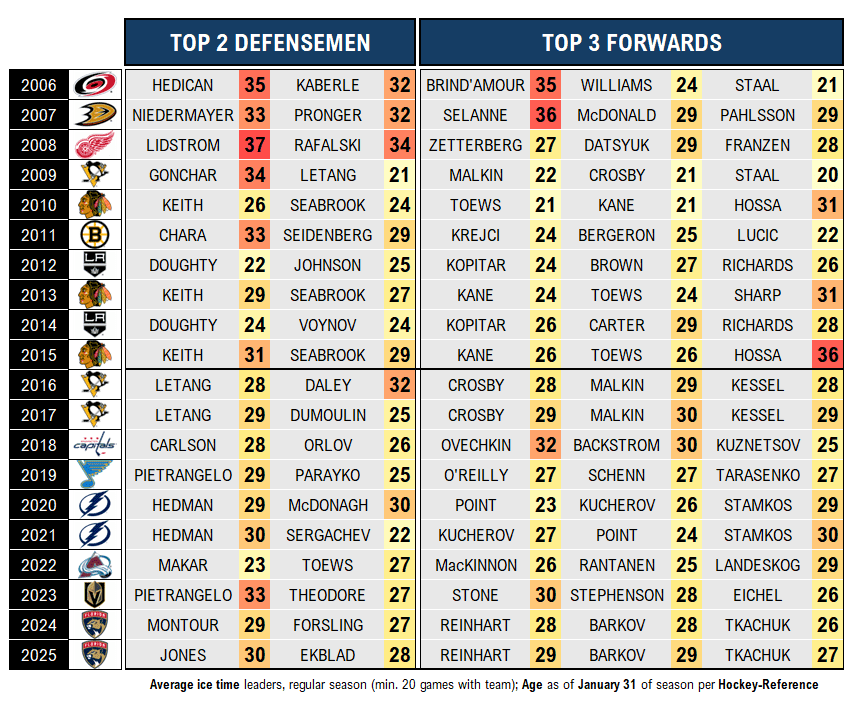
Before the 2004-05 lockout, Cup-winning coaches could carve out big minutes to hockey geriatrics. At age 40, Ray Bourque led the 2001 Avalanche to the Cup averaging a team-high 26:06. On the 2002 Detroit Red Wings? You had to go all the way to eighth in forward ice time to find someone under 30 years old — future Hall of Famer Pavel Datsyuk. The pace of the sport and the lack of trust in young talent allowed it.
Coming out of the lockout, the playoffs remained an elder statesmen’s game. The first three Cup winners in the graphic above leaned exclusively on defensemen 32 or older. But something shifted when the fresh-faced Pittsburgh Penguins broke though in 2009.
The salary cap had settled in — chasing veteran free agents was more difficult and relying on young, inexpensive talent was now necessary. Rule changes had led to hockey evolution — a faster, less-violent brand limited obstruction and head shots, rendering unskilled depth players extinct. Sports science and analytics further offered a better understanding of optimal player deployment.
No matter how it arrived, Cup winners can’t anchor to players north of 30 years old anymore. The red and dark orange fade from the visual above as you move from top to bottom:
- In the first 10 years of the cap era (2006-2015), there are 14 core skaters over 30.
- In the last 10 years of the cap era (2016-2025), there are just three core skaters over 30.
- In the last seven seasons, only one player over 30 — Alex Pietrangelo (2023) — played top minutes.
Of course, not all players age the same. And if a 29-year-old instead of a 31-year-old was three seconds of ice time from being in the chart above, it doesn’t change a franchise’s outlook. But the overall age trend of key players on championship teams is too noticeable to ignore.
⌛ Age is Not Just a Number (in Hockey)
Let’s apply our age-based takeaways to the 2026 playoff field.
Eastern Conference
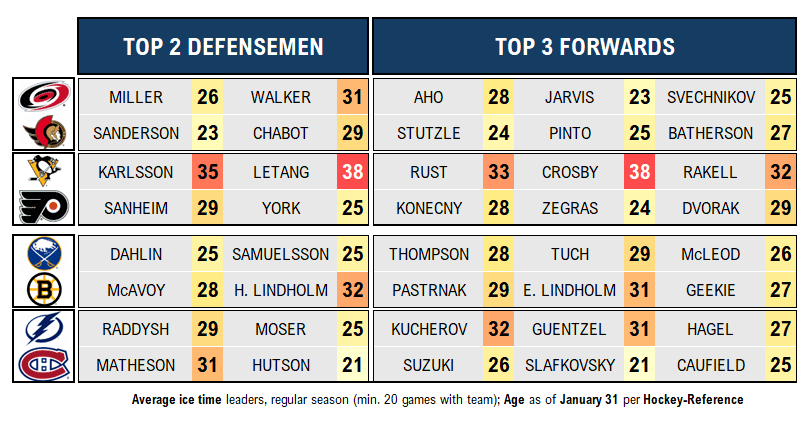
NO CHANCE: Everyone loved Pittsburgh‘s season. The Pens were legitimate first-round favorites in a weak division. But their top five were never going to hold up. Incredibly, of the 40 Eastern Conference centerpieces above, Pittsburgh employed each of the five oldest. Evgeni Malkin, their next forward, was 39. Boston‘s retool is commendable but their core is already nearing its best-before date — all five players above will be 28 to 33 next season and figure to occupy similar roles.
RIGHT ON TIME: Up-and-comers Buffalo, Ottawa, and Philadelphia give their minutes exclusively to players in their age-29 season or younger. Carolina is nicely balanced to compete for years, with Sean Walker (31) its only listed player north of 28. Montreal‘s core also has significant runway. While they still lean on Mike Matheson (31), Lane Hutson and Noah Dobson are poised to run the Habs’ blueline for years. Their youth outlasted the favored but older Lightning in Round 1.
AGING FAST: Tampa Bay‘s contention window was extended by actively finding younger replacements. Steven Stamkos was axed for Jake Guentzel. As Ryan McDonagh (36) and Victor Hedman (35) faded, younger models Darren Raddysh and J.J. Moser took their minutes. Brandon Hagel over Brayden Point. But as shrewd as Julien BriseBois has been, the rusty Bolts can no longer win a playoff round. As Nikita Kucherov approaches 33, the Fountain of Youth tap has predictably gone dry for Tampa come postseason time.
Western Conference
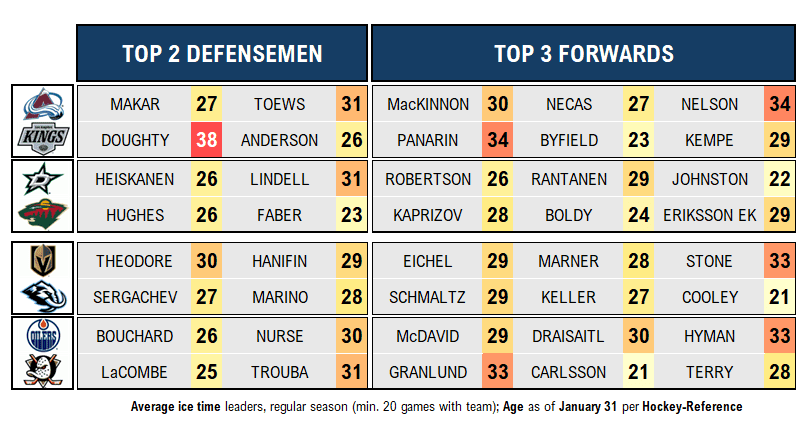
NO CHANCE: Ken Holland curiously swung big at the Trade Deadline. But Los Angeles, anchored by Drew Doughty (38) and Artemi Panarin (34), are too reliant on ‘unc’ status to seriously compete.
RIGHT ON TIME: A number of Western teams are aged right for success. Despite a brutal first-round matchup, Dallas is still in great shape for next year — Thomas Harley (24) is waiting in the wings on defense. Minnesota is equally well-primed; like Dallas, it will need an injection of young, impact forwards sooner than later. Utah is probably a little older than most realize but their core has good years left. While Anaheim is leveraging seasoned vets John Carlson, Alex Killorn, Mikael Granlund, and Jacob Trouba in this playoff run, there are layers of young talent ready for tough future assignments.
AGING FAST: Colorado ran the table this year, so let’s not draft their obituary yet. But the Avalanche would be the first Cup winner since the 2007 Ducks with three players in their core five in their age-30 seasons or older. Brock Nelson (34) would be the oldest top-three forward since Marian Hossa (2015). Colorado is a collective juggernaut, but its big dogs and depth players have surely peaked individually.
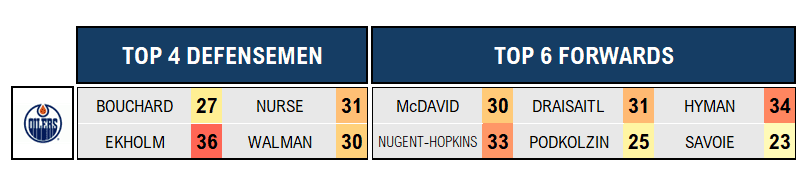
Much of the same can be said for Vegas and Edmonton, who finished 26 and 28 points, respectively, behind Colorado, only in a sad sack division. Let’s focus on the Oilers. Proper rest this offseason, paired with credible goaltending, and some depth adds should do wonders for a tired group. But history says Edmonton’s best window may be sealed.
Here are their players currently under contract next year, based on 2025-26 ice time. Let’s just say it’s getting late in the third period…
⭐ Superstars & Stanley
I’m not trying to scare Oilers’ fans. They’ve been through enough. But the ages of star players when they win their last Cup is objectively unsettling.
Excluding McDavid, here are the top eight forwards of all-time — ranked by PPS, my comprehensive Hall of Fame metric — shown with their age in the season of their last Stanley Cup. For context, 2026-27 will be McDavid’s age-30 season and Leon Draisaitl’s age-31 season.
| Player (Cups) | Age at Last Cup |
| Wayne Gretzky (4) | 27 |
| Mario Lemieux (2) | 26 |
| Sidney Crosby (3) | 29 |
| Gordie Howe (4) | 26 |
| Jaromir Jagr (2) | 19 |
| Alex Ovechkin (1) | 32 |
| Howie Morenz (3) | 28 |
| Phil Esposito (2) | 29 |
The average age at the time of their final Cup was 27 years old. Only Ovechkin was older than McDavid will be next season.
But most of these players played in a much different NHL. The league was smaller and dynasties ruled. Let’s check out some contemporary names. Here are the top 20 forwards in PPS that debuted in the cap era and are at least 35 today. Each player is listed with the year(s) of their Cup rings.
| Player | Cup Ages | Player | Cup Ages |
| Sidney Crosby | 21, 28, 29 | Ryan Getzlaf | 21 |
| Alex Ovechkin | 32 | Corey Perry | 21 |
| Evgeni Malkin | 22, 29, 30 | Jamie Benn | None |
| Patrick Kane | 21, 24, 26 | Claude Giroux | None |
| Steven Stamkos | 29, 30 | Tyler Seguin | 19 |
| Brad Marchand | 22, 36 | Phil Kessel | 28, 29, 35 |
| Jonathan Toews | 21, 24, 26 | Zach Parise | None |
| John Tavares | None | Jeff Carter | 27, 29 |
| Anze Kopitar | 24, 26 | Max Pacioretty | None |
| Joe Pavelski | None | Blake Wheeler | None |
Of the 13 forwards above who won Cups, all but Ovechkin had won by 29. Seven won’t (or haven’t) lifted the Cup, though Tavares, Benn, and Giroux remain active. If we park Kessel’s four playoff games at 35 with Vegas and Marchand’s second Cup as a rental at 36 last season, only Ovechkin played on a Cup winner wire-to-wire in a prominent role after 30. That’s among 27 titles above.
This is certainly not to say McDavid can’t win a Cup in Edmonton, or elsewhere. He’s not your everyday star. Aside from a few stretches with lingering injuries, McDavid often looked as good as any player who ever lived this season. But he’s at an age where injuries creep, which we saw against Anaheim. Both McDavid and Draisaitl have been banged up more often in recent seasons. Winning a series singlehandedly stops becoming an available cheat code. Ask Crosby, who hasn’t won a playoff round post-30. Celebrated playoff heroes Kane, Toews, and Kopitar never saw the Second Round after turning 26.
All of the above collectively supports that teams relying on players over 30 can’t seem to survive the postseason anymore. Absent younger legs to step in, they simply run out of gas.
Is the solution limiting the roles of aging talent as an act of playoff preservation? Should veteran-led franchises break up sooner? These are tough questions in an NHL where stars get locked up long-term, young talent comes through the draft, and trades are scarce.
Time is the blade that never dulls… and it sharpens come playoff time.
Data from Hockey Reference; all ages as of January 31 of season