Long live the King: How good was Anze Kopitar anyway?


The sun is setting on Anze Kopitar’s career.
After 20 decorated seasons in black, silver, and white, the Los Angeles Kings‘ captain is retiring. Kopitar’s crew is still hanging around the Western Conference’s pillow-fight playoff race. But his legacy is long secured.
No one wants to admit that coastal biases exist. But they do. It’s more like coastal reality. I watch a lot of hockey and have throughout Kopitar’s career. I’ve rarely seen him play a full game. All I can picture is a big body with deep-set, blue eyes quietly controlling play. It’s inevitable in a league covering four time zones. Western media and fans rarely catch Zach Werenski at 4 p.m. PST on a Tuesday, either.
So, how good was Kopitar?
As we often do in this space, we’ll turn to the numbers. Yes, there’s much more to a hockey career. Leadership, international impact, community contributions. They all matter in the life of an athlete. But we’ll park the intangibles and focus solely on Kopitar’s on-ice impact. Was he a very good player for a very long time? A first-ballot Hall of Famer? Underappreciated? Overrated? Let’s find out…
🚨 Offense
The Narrative: Kopitar is the all-time leading scorer in Kings’ franchise history, passing Marcel Dionne’s points record earlier this month.
Few players in NHL history have epitomized the No. 1, all-situations center like Kopitar. At his peak, he averaged 22:18 per night. At 38, Kopitar’s still getting nearly 19 minutes and winning 56% of faceoffs. Despite the eye-popping career totals (1,311 points), his scoring production was limited by a franchise that tried to win through goal prevention — not by outscoring opponents.
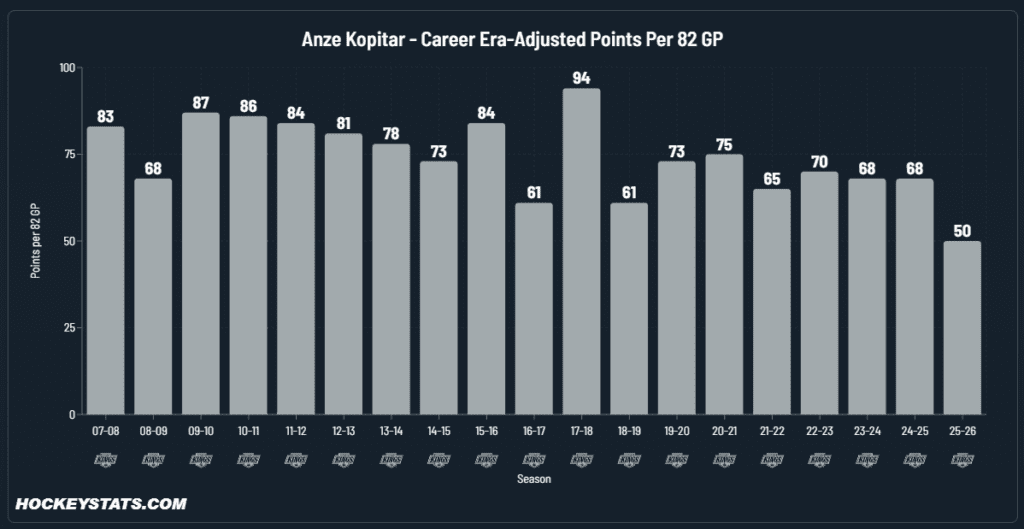
A look at Kopitar’s yearly output above — scaled to a neutral scoring climate and 82 games — shows a reliable contributor, not a superstar scorer. The Slovenian’s point production is best described as high floor, low ceiling. Elite scorers in their primes don’t sandwich a career-high 94 adjusted point pace with two adjusted 61-point pace years. Kopitar did not have the prolific offensive game (or team environment) to compete for scoring titles. His lone top-10 finish in points was seventh-place (92 points) in 2017-18.
👑 Verdict: Rarely an elite scorer, Kopitar was skilled and durable enough to retire 20th all-time in era adjusted points (1,436).
🛑 Defense
The Narrative: As one of 11 players with multiple Selke Trophies, Kopitar is one of the greatest defensive forwards to ever live.
Players like Kopitar who contribute offensively and play a responsible defensive game get the prestigious label ‘two-way forward.’ It’s a hazy title at best, often awarded for life without regular checkups. Among the two-way threats, few have garnered Kopitar’s level of respect.
Here are the 10 forwards that have finished top-five in Selke voting at least six times.
Most Top-5 Selke Trophy Finishes (Introduced in 1977-78)
| Player | 1st | 2nd | 3rd | 4th | 5th | Total |
| Patrice Bergeron | 6 | 4 | 2 | 1 | 1 | 14 |
| Guy Carbonneau | 3 | 2 | 1 | 2 | 1 | 9 |
| Pavel Datsyuk | 3 | 0 | 3 | 0 | 1 | 7 |
| Anze Kopitar | 2 | 1 | 1 | 1 | 2 | 7 |
| Michael Peca | 2 | 1 | 1 | 0 | 3 | 7 |
| Craig Ramsay | 1 | 3 | 2 | 0 | 1 | 7 |
| Jonathan Toews | 1 | 2 | 1 | 2 | 1 | 7 |
| Jere Lehtinen | 3 | 1 | 2 | 0 | 0 | 6 |
| Alexsander Barkov | 3 | 0 | 1 | 1 | 1 | 6 |
| Ryan Kesler | 1 | 2 | 2 | 0 | 1 | 6 |
In the near half-century of the Selke Trophy’s existence, only Patrice Bergeron (11) and Guy Carbonneau (nine) have more top-five finishes than Kopitar’s seven. Do the underlying defensive metrics match his reputation?
They do…
Throughout his 20s in particular, Kopitar was an exceptional play driver at 5-on-5 — both offensively and defensively. By both HockeyStats.com and Dom Luszczyszyn’s Net Rating, Kopitar is among the career leaders in even-strength defensive contributions in the salary-cap era. An interesting takeaway from the data is that, despite regular usage, Kopitar was mostly a poor to average penalty killer in his prime.
👑 Verdict: Kopitar is rightfully regarded as one of top two-way forwards ever and belongs on the short list of Selke-worthy studs of his generation.
🥅 Overall Value
The Narrative: Kopitar is one of the better forwards of the cap era. While not in the upper tier of perennial MVP candidates, he belongs in the next wave of superstars.
In February 2025, our Daily Faceoff team ranked the top 25 players of the past 25 years. Kopitar ranked as the #24 player, the 16th forward on the list. The 6-foot-3 center was ultimately left off the NHL’s version. But it was selected by fan vote and had the usual dubious choices such lists attract.
For those unfamiliar with WAR (Wins Above Replacement), it’s a comprehensive estimate of player value. WAR goes deeper than basic box score stats to identify player contributions. Using HockeyStats.com’s version, Kopitar ranks extremely high. Like, legendarily high.
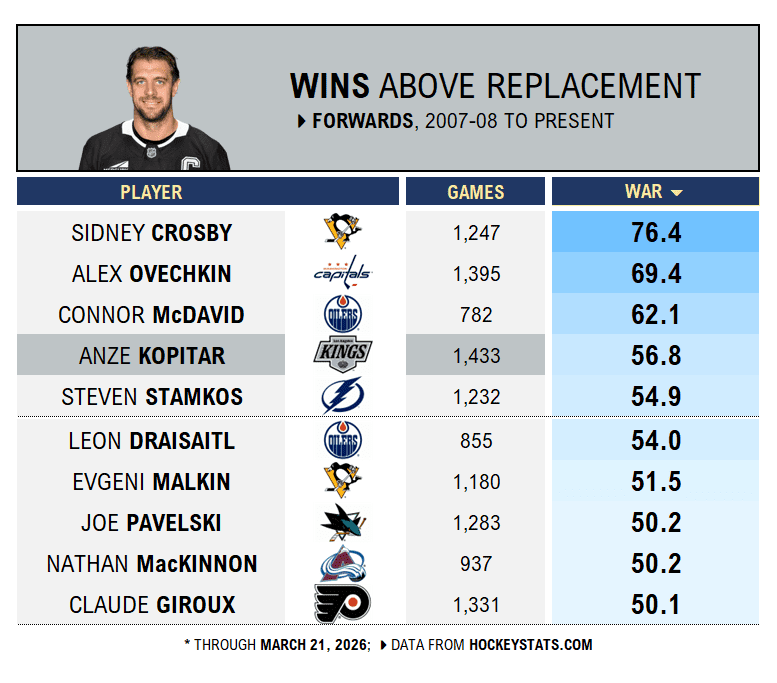
The career totals above favor Kopitar as the information is available for 19 of his 20 seasons. Incredibly, Kopitar ranks fourth in WAR among forwards since 2007-08. Yes, Steven Stamkos should pass him. Evgeni Malkin could pass him. Leon Draisaitl, Nathan MacKinnon, Auston Matthews, David Pastrnak, Nikita Kucherov, and a few others, almost certainly will pass him. But Patrick Kane won’t. Nor did the defensive savants of his era, Jonathan Toews and Patrice Bergeron. Advanced metrics love Kopitar, celebrating his on-ice impact beyond raw point totals that often start and end hockey conversations.
Kopitar has the highest game count of any player in the analytics era, so his timing and exceptional health give him an edge in adding value. But playing a lot of games at a high level is a feat in itself, one nearly every NHL player fails to achieve.
👑 Verdict: There’s a valid statistical argument that Kopitar contributed top-five career value among forwards in the analytics era.
🏆 Playoffs
The Narrative: By leading Los Angeles to two Stanley Cups, Kopitar had one of the most successful playoff careers of the cap era.
From the Western Conference’s eight-seed in the 2012 postseason to two Stanley Cups in a three-year span, Kopitar helped usher a new era of winning in L.A. While Jonathan Quick (2012) and Justin Williams (2014) snagged the Conn Smythe Trophies, it was Kopitar that led the playoffs in scoring both years.
How rare is that feat? Here are the five players since 1989 that have led the playoffs in points and lifted the Cup in the same year twice:
- Mario Lemieux, 1991 & 1992
- Joe Sakic, 1996 & 2001
- Evgeni Malkin, 2009 & 2017
- Anze Kopitar, 2012 & 2014
- Nikita Kucherov, 2020 & 2021
Extremely impressive company.
But the split of Kopitar’s postseason career is shocking — a three-season blast of remarkable success wedged around 16 years of playoff irrelevance.
| Age | GP | G | A | PTS | Series Record | Stanley Cups | |
| First 5 Seasons | 19 to 23 | 6 | 2 | 3 | 5 | 0-1 | 0 |
| 2012 to 2014 | 24 to 26 | 64 | 16 | 39 | 55 | 10-1 | 2 |
| Last 11 Seasons | 27 to 37 | 33 | 9 | 20 | 29 | 0-6 | 0 |
| Total | 103 | 27 | 62 | 89 | 10-8 | 2 |
Now, only one of 32 teams lifts the Cup. And flags fly forever. Kopitar comfortably led Kings’ forwards in ice time on both Cup runs, an irreplaceable weapon seemingly built in a lab for 2010s playoff hockey.
But Kopitar’s two decades in Los Angeles also featured: eight playoff misses; seven teams with 98 points or more that got bounced in the first round. Other than the 2012 to 2014 run, Kopitar has played 39 playoff games… in 16 seasons. Hard to believe. While hardly Kopitar’s fault, it takes some of the shine off the group’s place among the era’s titans.
Compared to the conference finalist windows of contemporary heavyweights, we get: Pittsburgh‘s Crosby/Malkin (10 years, 3 Cups); Chicago‘s Kane/Toews (7 years, 3 Cups); Tampa Bay‘s Stamkos/Hedman (12 years, 2 Cups). The Kopitar/Doughty run lasted just 26 months. More kings for a day than kings of the hill.
👑 Verdict: Kopitar was instrumental in delivering two Stanley Cups in three years to Los Angeles, but he didn’t win a playoff series before and hasn’t since.
👑 Legacy
The Narrative: Kopitar is a Hall of Fame lock.
A few years ago, I introduced PPS, a comprehensive metric that measures a player’s Hall of Fame worthiness in a single digit. The standard for a modern forward is a score of 217. Through last season, Kopitar scored 245. This season won’t add much to his score — he’ll retire at 246, or 247 if the Kings can reach the postseason. Either way, Kopitar has long been qualified for the Hall, illustrated by his PPS card below.
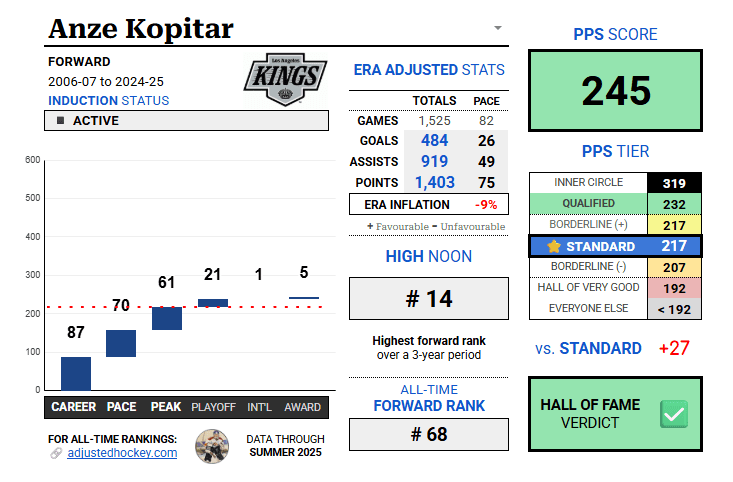
Only three eligible forwards above Kopitar in PPS aren’t elected to the Hall — John LeClair (258), Keith Tkachuk (257), and Theo Fleury (255). LeClair’s dominant peak and Tkachuk’s exceptional sniping remain camouflaged by The Dead Puck Era. Fleury’s post-hockey life keeps him from induction. The only similar player excluded is Patrik Elias (246), another two-way force with a pair of Cup rings on a defensive-minded franchise. But Kopitar will retire with much bigger career totals and two Selkes. He’s a lock.
Will it be first ballot?
That distinction is often a function of timing. The Class of 2029 could feature many heavy hitters. Or none. Most suspect that if Ovechkin, 40, exits the NHL this summer, he will play in Russia. Jaromir Jagr, 54, has said this would be his last gasp… but he’s been saying that so long it’s hard to believe. Former Blackhawk teammates Kane and Toews, both 37, could retire. Two-time Vezina winner Sergei Bobrovsky, 37, is without a contract. Norris winner Brent Burns, 41, Hart winner Corey Perry, 40, Kopitar’s former teammate Quick, 40, and Claude Giroux, 38, haven’t committed to next season.
Two summers ago, I speculated Kopitar would enter on the first try in 2029. Much has changed since then. But Kopitar’s place in hockey’s pantheon hasn’t. Only under some perfect storm where Ovechkin, Jagr, Kane, and Toews all retire at once should Kopitar be stymied in 2029.
👑 Verdict: Kopitar should be inducted as a first-ballot Hall of Famer in 2029. Long live the King.
Data from Hockey-Reference; HockeyStats.com
_____
Recently by Paul Pidutti
- 2026 career projections: Will McDavid, Crosby or MacKinnon reach 2,000 points?
- Setting up the major stat races on the NHL’s stretch drive
- Are first-round draft picks overrated trade targets?
- Ranking the retools: Canucks light years from Cup contention, Islanders trending up
_____
PRESENTED BY STAKE
