2026 Stanley Cup Playoffs: Penguins vs. Flyers series preview

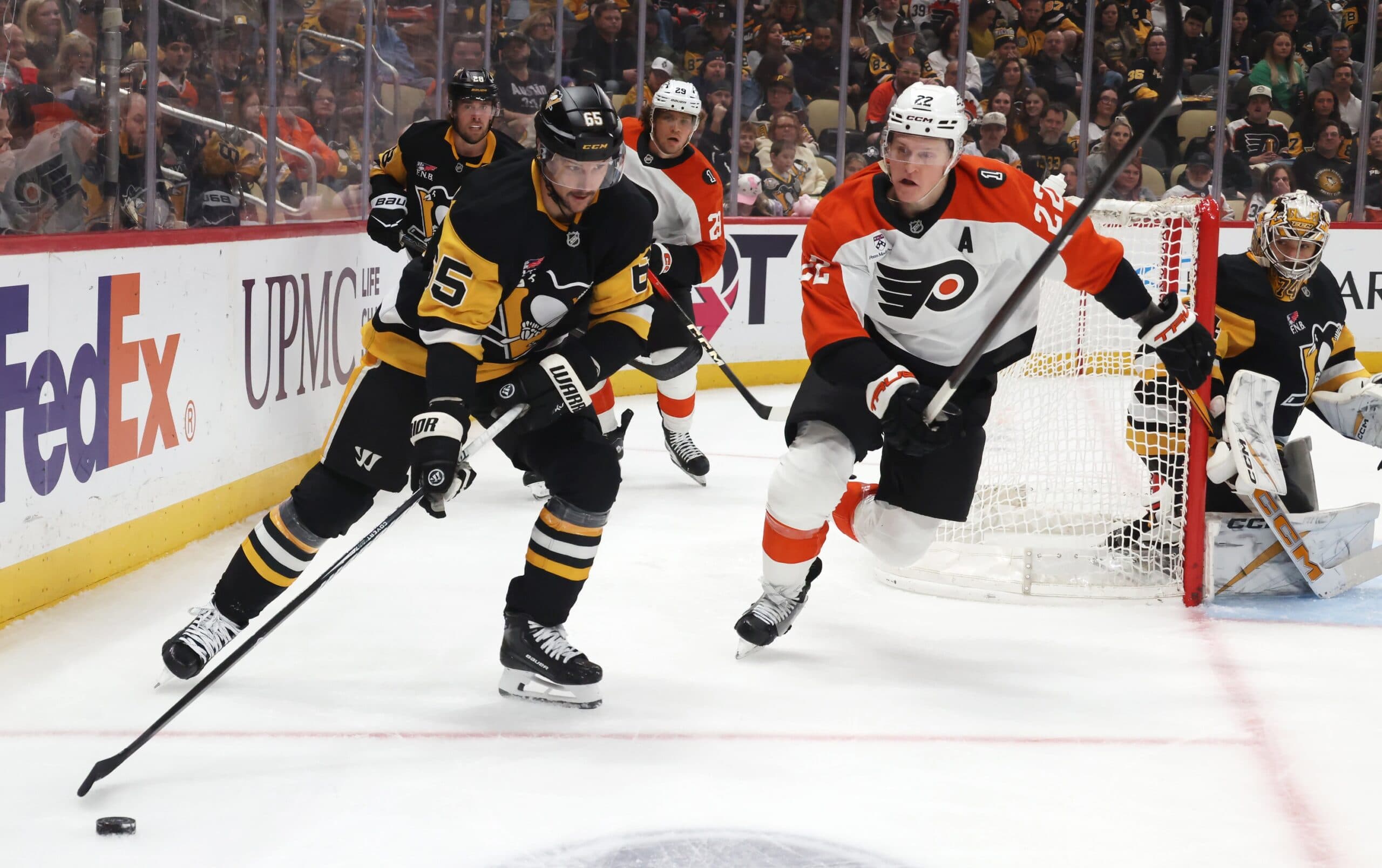
Pittsburgh Penguins: 2nd in Metropolitan Division, 98 points
Philadelphia Flyers: 3rd in Metropolitan Division, 98 points
Schedule (ET)
| Game # | Date | Game | Time (ET) |
| 1 | Saturday, April 18 | Philadelphia at Pittsburgh | 8:00 PM |
| 2 | Monday, April 20 | Philadelphia at Pittsburgh | 7:00 PM |
| 3 | Wednesday, April 22 | Pittsburgh at Philadelphia | 7:00 PM |
| 4 | Saturday, April 25 | Pittsburgh at Philadelphia | 7:00 PM |
| 5 | Monday, April 27 | Philadelphia at Pittsburgh* | TBD |
| 6 | Wednesday, April 29 | Pittsburgh at Philadelphia* | TBD |
| 7 | Saturday, May 2 | Philadelphia at Pittsburgh* | TBD |
*if necessary
The Skinny
The Penguins did not expect to be here. General manger Kyle Dubas’s decision to part company with Mike Sullivan, who coached the Pens to 400 wins and a pair of Stanley Cups, in favor of rookie bench boss Dan Muse, a 42-year-old former developmental coach, was a clear sign that maximizing the remainder of Sidney Crosby’s prime had shifted from the priority to merely one of many priorities.
Turns out, it’s not just kids and castaways Muse can connect with. Erik Karlsson would be in with a shout to win a fourth Norris Trophy if it weren’t for a preposterously crowded field. Evgeni Malkin spent a full season on the wing for the first time in his life, where his passing vision and strength on the puck more than made up for his lack of footspeed and the penalties that come with it. Crosby is, well, Crosby.
That all amounted to a strong start for the Pens (14-7-5), but it was only after a brutal eight-game December skid (0-4-4) that dropped them into fifth place in the Metropolitan Division that Pittsburgh got to show its mettle; the veteran club surged back into playoff position with a dominant 15-4-3 run (+30 goal differential) into the Olympic break. They haven’t looked back.
The Flyers weren’t supposed to be here, either. A fanbase that had been decrying Philadelphia’s “old boys’ club” for decades was none too interested in Rick Tocchet’s CV. One of the finest (and most fearsome) players in team history, Tocchet could only have been hired by former teammates Keith Jones and Daniel Briere for that reason.
A winning start (22-12-7) did little to placate Tocchet’s vocal contingent of critics, given Philadelphia’s low-event style and the coach’s unwillingness to let prized youngster Matvei Michkov’s talent excuse his frequent mental errors. The Flyers’ putrid subsequent form (3-8-4) ahead of the break gave those critics all the courage they needed to shout “I told you so!”
What the team has achieved since has lowered that cacophony of abuse to a whisper. The Orange and Black didn’t suffer a single three-game losing streak after the break and locked up their first postseason since 2020 with a final 6-1 flurry (28-14 combined score). They aren’t just winning either; blazer Owen Tippett, shootout maven Trevor Zegras, rookie sensation Porter Martone, and, yes, Michkov have succeeded in making Tocchet hockey fun.
So, two teams with their pockets full of house money must just be happy to be here, right? Guess again. Hatred between these organizations spans generations. Jagr-Therien. Talbot-Carcillo. Crosby-Giroux. Between sworn enemies, the only moral victories are actual victories.
Head to Head
Pittsburgh: 2-0-2
Philadelphia: 2-2-0
The Battle of Pennsylvania’s season series has closely resembled either club’s overall results, with wins past regulation for Philadelphia in October and March bookending a pair of Pittsburgh romps (11-4 total score).
The Penguins won high-event games during which they exploited emotional contests to draw power plays, where they shredded the Flyers’ so-so kill (77.6%, 22nd) for six total goals to the tune of a ridiculous 75% conversion rate on the man-advantage. One stat that will surprise 0 Philadelphians is that neither Crosby (3 G, 4 P) nor underrated Flyer killer Bryan Rust (2 G, 6 P) went pointless against their rivals in a game this season.
The Flyers’ own pair of Ws closely corresponded with stronger efforts on the PK (9/10) but also came in games that followed Tocchet’s preferred script as Philadelphia dragged close contests into overtime, which I’ll describe further in the “X-Factor” section. Zegras’s ability to step up in big games (3 A) was typical of his brilliant maiden season in Philly. Fellow key acquisition Dan Vladar (1-1, .840 SV%) was less impressive against the Pens.
Top Five Scorers
Pittsburgh
Sidney Crosby, 74 points
Erik Karlsson, 66 points
Bryan Rust, 65 points
Anthony Mantha, 64 points
Evgeni Malkin, 61 points
Philadelphia
Travis Konecny, 68 points
Trevor Zegras, 67 points
Owen Tippett, 51 points
Matvei Michkov, 51 points
Christian Dvorak, 51 points
Offense
For all the coverage of the Penguins’ experience and camaraderie, they’re in the Stanley Cup playoffs because they score goals. Lots and lots of goals. Their 290 tallies were the third-most in the NHL this season, and their power play finished seventh (24.1%).
There were goals from Crosby (29 G), who just wrapped up an NHL-record 21st consecutive season above a point a game; from Rust, the ultimate high-motor competitor, who matched his captain and linemate’s total; from intelligent sniper Rickard Rakell (24 G), who’s found a different gear (11 G in 22 GP since 3/1) since splitting from Crosby’s trifecta to center his own line. The old guard is only part of the reason Pittsburgh is so dangerous, though.
Hidden gem Egor Chinakhov’s elite wheels (97th percentile in top speed, per NHL EDGE) and shot (99th percentile in hardest shot) have fit right in (18 G, 36 P in 43 GP) since his trade from the Columbus Blue Jackets. Anthony Mantha, plucked from free agency eight months removed from an ACL tear, has potted a team-high 33 tallies with obscene efficiency from 18-year-old rookie Ben Kindel’s third line (21.7 S%, 15:11 ATOI).
All told, the Pens have an astounding 12 skaters with at least 13 goals this season, including, of course, Karlsson. Down the stretch, ‘EK65’ has played the best hockey Pittsburgh fans have seen from him (11 G, 31 P in 23 GP) since 2017, when he was playing for the opposition Ottawa Senators in the Eastern Conference Final.
The numbers bear out a mismatch on the offensive side of the puck (PHI scored 50 fewer goals than PIT), but the Flyers’ depth and performance over the final month (3.56 goals-per-game, sixth-most) are encouraging signs.
Travis Konecny has grown into a real playmaker (93 A since 2024) and led the club in scoring once again on a line with speedy two-way center Christian Dvorak (35-27 5-on-5 game score). Though Michkov hasn’t yet wrested the baton from ‘TK,’ Michkov came on strong down the stretch, especially as a passer (4 G, 18 P in 16 GP since 3/17). Still, the young Russian’s use in this series bears monitoring, given his proneness to penalties.
The second line, built around Zegras and Tippett, brings the electricity for Philadelphia. Zegras’s abundance of flair is translating to the scoresheet, and a big reason why is his connection with Tippett. Like Chinakhov, the ‘Red Rocket’ (I have alerted our lawyers to beware of Sammy Hagar) is a freak (99th percentile top speed, 93rd percentile hardest shot), except with an added layer of oomph (166 hits).
Konecny and Zegras did well to buoy a middling attack throughout the season, but a pair of late reinforcements could bring it to a boil. Back in the lineup after missing 49 games due to a freak injury, Tyson Foerster is a heavy-shooting (13 G in 29 GP), elite cornerman whose makeup screams “playoff hockey.” The same could be said of Martone after all of nine NHL games (4 G, 10 P). The 19-year-old power forward sure gets his looks (3.55 SOG per game), and already looks like the true danger man on Konecny’s line.
Defense
The Penguins love goals so much they allow them at an alarming rate (258 goals against, ninth-most). Karlsson’s pairing with versatile lefty Parker Wotherspoon (career-high 30 P, +16) can drive play (52.1% expected-goal share), but the veteran Swede always has a loud screwup on deck; the unit’s rate of expected goals against per 60 (2.69) would rank last among Philly’s regular pairings.
Wotherspoon and fellow out-of-nowhere contributor Ryan Shea, whose third pair with veteran banger Connor Clifton has been a brick wall (2.21 expected goals against per 60), have done their part to settle things down. Still, there are questions about the Pens’ defense beyond the ever-confounding Karlsson.
Kris Letang is still a physical beast at age 38, but there’s a shakiness to his game you wouldn’t expect given his experience. Letang’s partner, diminutive puckmover Sam Girard, can struggle with high physicality. The Quebecois duo must be careful not to let a Philadelphia forecheck led by Tippett and captain Sean Couturier smell blood in the water.
For the Flyers’ part, the aim of Tocchet, who won three Stanley Cups with the Penguins (one as a player, two as an assistant), is to keep shooters to the outside, a team-wide effort that starts with Olympic standouts Travis Sanheim (CAN) and Rasmus Ristolainen (FIN).
Sanheim, whose game is all about elite speed in recovery and on the pinch, returned from Milan at his very best (12 P, +11, 25:47 ATOI in 24 GP). Ristolainen’s days as a high scorer in Buffalo are a fading memory, but his evolution into an open-ice punisher has made him more effective than ever. The hulking duo has kept things airtight (2.29 expected goals against per 60) since teaming up in January.
Since ‘Risto’ ended his longstanding No.1 duo with Sanheim, Cam York has partnered with former USNTDP teammate Jamie Drysdale. It’s a bit of an odd duo, a unit made up of two undersized defenders whose puck skills are better suited to escaping danger than creating it at the other end. Drysdale’s ability to skate out of trouble and quash rushes with speed has made him an eye-test standout, but the pair’s metrics are middling.
Further up the ice, the Penguins get most of their forechecking from a fourth line of Noel Acciari, Connor Dewar, and Blake Lizotte, who have coupled surprising production (34 combined G) with solid puck control (56.15% scoring-chance share). The Flyers distribute two-way impact players throughout their lineup. Foerster’s elite play on the wall wins the puck at both ends, bull-strong center Noah Cates led the team in rating (+26), and former Selke winner Couturier (career-high 100 hits) has reinvented himself as a bruiser since a fortuitous demotion to the fourth line.
Goaltending
The well-worn axiom that goalies are weird typically refers to their personalities. Their aversion to stepping on painted lines. Their tendency to shut themselves off from the world on game days. In these ways, Stuart Skinner is not weird. By all accounts, he’s a great guy who approaches his dream job with professionalism and gratitude.
As a player, though? It doesn’t get any weirder than Skinner, who has done just enough (.885 SV%, .556 Quality Start%) to earn the net for Game 1 since the Penguins and Oilers swapped goalies. The Alberta boy lost his net in two consecutive postseasons only to transform into Martin Brodeur in time for the Western Conference Final. With Skinner, you never know if you’re going to get the shooting board or the brick wall.
It doesn’t seem like a mental thing. Big Stu is unbeatable if he can get that 6’4” frame square to shooters all game, but he’s a poor skater who’s quite helpless at moving from post-to-post. Can Flyer playmakers Zegras and Michkov keep Skinner’s head on a swivel? Or will their team’s hard-on-pucks, north-south game play right into his hands?
As for Philadelphia netminder Dan Vladar, the only weird thing going on is that it took 28 years for anyone to figure out this guy can play. In his first season as a workhorse starter, Vladar (.906 SV%, .725 Quality Start%) won the fittingly-named Bobby Clarke Trophy as the Flyers’ MVP.
The result was never in question. A lanky athlete who covers a lot of net, Vladar has thrived behind a Philly defense that tries to make his life easy by keeping shooters to the outside. Failing that, they can rely on an .832 high-danger SV% that ranked 10th among full-time goalies (min. 2,000 minutes).
The question for the Flyers is how valuable keeping pucks to the outside really is when that’s the area where Karlsson makes his living. Hopefully, ‘Darth’ Vladar has figured out the secret antidote for Karlsson that has eluded the rest of the league for 17 years.
Regarding backups, Conan scribe Robert E. Howard would likely describe each of Philadelphia’s Sam Ersson and Pittsburgh’s Arturs Silovs as capable of gigantic melancholies and gigantic mirth. That is to say, both players always seem to pull a five-star performance out of the hat just as it seems they’ve played their way out of the National. It keeps them in work, at least.
Injuries
Go fish.
For the Pens, Lizotte is back practising after a month on the schneid. It seems he will assume soft-handed bruiser Justin Brazeau’s (17 G,90 hits) place in the lineup as monstrous puck protector Elmer Soderblom (6’8”, 252 lbs) slides up to the third line.
On the Flyers side of things, Rodrigo Abols was unfortunate to see his season end just ahead of a chance to represent Latvia at the Olympics but has long since been replaced by waiver claim Luke Glendening as the fourth-line center. Affable Russian Nikita Grebenkin is listed as out (upper-body) but would be unlikely to break up a rookie rotation of Alex Bump and Denver Barkey on the third line or a veteran battery of Garnet Hathaway and Carl Grundstrom on the fourth.
Intangibles
What breaks first? The team that doesn’t know how painful, how taxing, how often futile the cauldron of the Stanley Cup Playoffs can be? Or the team that does?
Crosby is a pre-eminent competitor who would never shy away from the opponent he most loves to torment. Malkin and Letang are all too aware of how special it is to get this chance, perhaps their last at a fourth Cup. Karlsson, Rakell, and Rust are thrilled to have another crack at the postseason; they’ve spent the tail end of their respective primes chasing this opportunity down. Isn’t it possible, though, that some subconscious discouragement can set in when these old timers remember just how difficult this dance is?
At the other end of the spectrum, the Flyers’ youthful enthusiasm for what is a first postseason appearance for everyone from Cates down to Zegras could easily end in a stiff reality check. There is nothing to prepare you for playoff hockey except for playoff hockey. Crosby learned that when the Sens sent him home in five in 2007. Zegras will learn that. Cates will learn that. Martone, who is playing in a tournament format for the third time this season, will learn that. Are they quick enough studies to make it to the second round?
X-Factor
The only teams in the Eastern Conference that have won fewer games before the extra frame than the Flyers (27) are the lowly Maple Leafs and lowlier (?) Rangers. In some corners, that statistic has been taken to mean that Philadelphia must not be very good.
That’s uncharitable. The Flyers didn’t slow the game down in all those third periods or rag the puck in all those 3-on-3s out of ineptitude. They did it to give themselves the best chance to win hockey games under the same rules that apply to 31 other NHL teams.
That chance was in the shootout, where each of Zegras (58.8 S%, best all-time, min. 20 attempts), Ersson (.771 SV%, 10th all-time), and Vladar (.745 SV%, 21st) has a historic success rate. And it worked; the Flyers went 10-4 in shootouts.
If you haven’t heard, there are no shootouts in the playoffs, nor are there 3-on-3s. The Flyers won all those games fair and square, sure, but can they win four more at 5-on-5? There’s no safety valve, now, and the Penguins (34 regulation wins) haven’t had to rely on one nearly as often.
Series Prediction
This is my fourth postseason writing these previews. The research that goes into them is extensive. I have never, in that time, encountered a matchup between two opponents who were more perfect opposites.
The Penguins are weathered and experienced. The Flyers are young and spry. Pittsburgh couples a dangerous attack with a porous defense. Philadelphia can slam the door shut but at times struggles to capitalize.
If it’s a stalemate, I’ll err on the side of the goalie. But I do expect a war.
Flyers in seven games.
_____
POST SPONSORED BY bet365
_____