Awards showdowns, playoff starting goalie decisions, and the top NHL storylines of April

Remember when Spencer Knight was backstopping the Chicago Blackhawks right into playoff darkhorse territory? What about when the Columbus Blue Jackets were even worse off than the Toronto Maple Leafs and New York Rangers in the Eastern Conference standings? Even by the typically chaotic standards of the NHL, the ebbs and flows of the 2025-26 season have hit more like tidal waves, changing the hockey landscape too quickly and too dramatically for the rest of us to keep up.
The campaign is winding down now, but with the Stanley Cup Playoffs just more than two weeks away, the high drama has only just begun.
A half-dozen teams in the East alone will battle for a dwindling number of playoff berths during their final handful of games, none of them more desperate than the long-suffering Detroit Red Wings. The only two NHL teams awaiting a near-certain matchup, the Central Division’s Dallas Stars and Minnesota Wild, will take little comfort from the titanic struggle that awaits them in the first round. A selection of elite players will continue to joust for individual honors, most of which remain up for grabs.
In other words, nothing is settled, even after six months and ~75 games. Read on for more on the major awards races, the playoffs, the Wings’ uncertain future, and more.
The Hart, the Vezina, and other trophies up for grabs
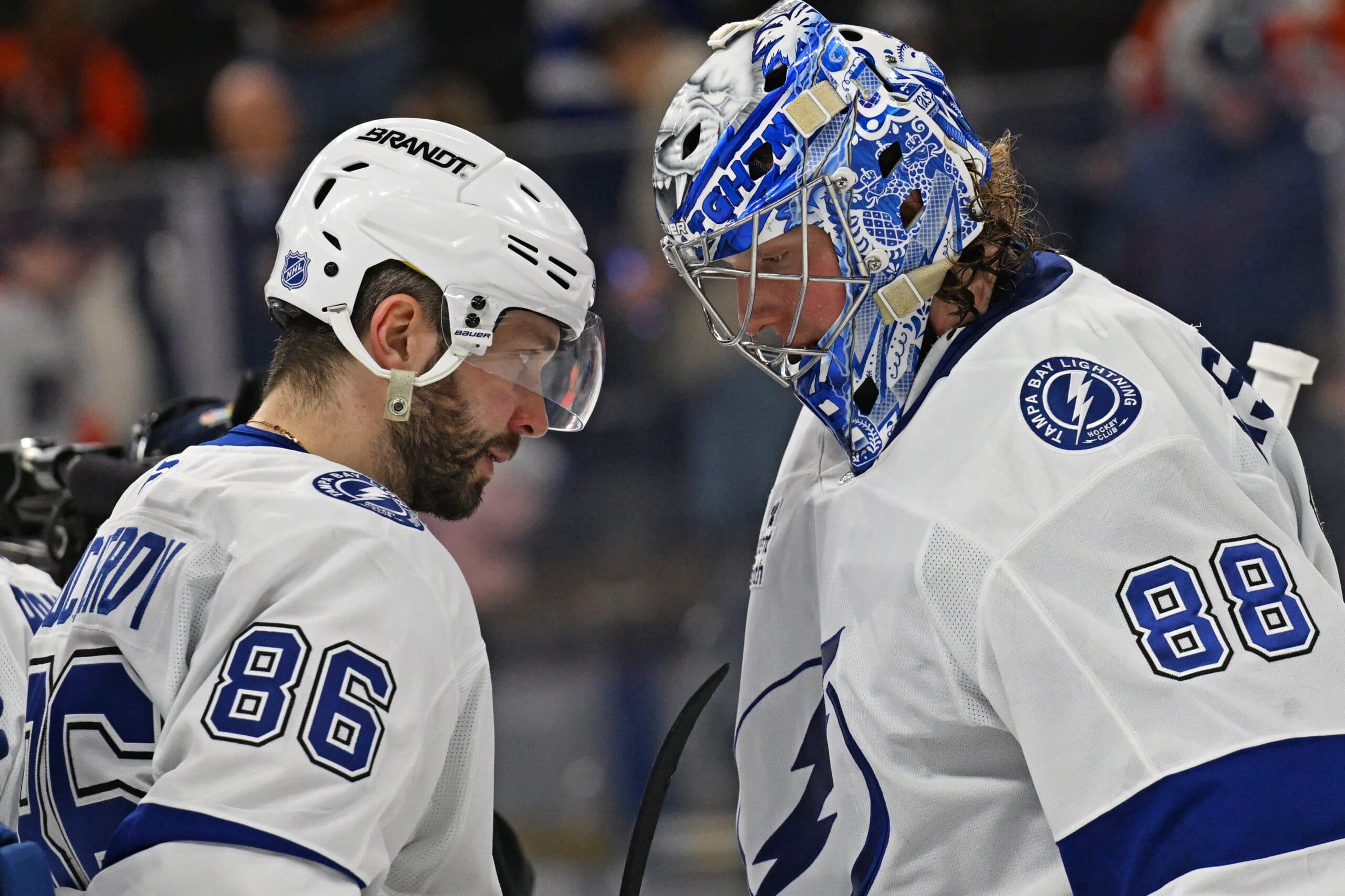
It wouldn’t be April without a fearsome battle between Nikita Kucherov (40 G, 121 P in 68 GP) and Nathan MacKinnon (49 G, 120 P in 72 GP). For two seasons running, Kucherov’s late-season outbursts have pipped MacKinnon for the NHL scoring lead and the Art Ross Trophy during the homestretch, with MacKinnon nonetheless holding on to win the Hart Trophy as league MVP in 2024. MacKinnon and Kucherov’s clash of styles and personalities will once again loom large on the awards podium as each man seeks his second Hart (Kucherov won the award in 2019). Will it be MacKinnon (league-high +56, 318 SOG), the relentless, irresistible straight-line attacker at the head of the Colorado Avalanche’s first-placed war machine, or Kucherov (league-high 1.78 points per game), the mercurial hockey savant keeping the Tampa Bay Lightning near the top of the standings despite a novel-length injury list? The oddsmakers are calling it a toss-up, so each player’s closing argument could factor heavily.
Though New York Islanders phenom Matthew Schaefer is a Calder lock, and it feels like it’s Columbus rover Zach Werenski’s (21 G, 78 P, 26:30 ATOI in 67 GP) turn to win the Norris after a near miss in 2025, other votes will similarly come down to the wire. Schaefer’s Isles teammate, Russian goalie Ilya Sorokin (2.59 GAA, .910 SV%, league-high 7 SO), seemed set for his own coronation based on his dominant peaks and his importance to a surprise playoff charge. Instead, Sorokin’s so-so March (6-7-0, .897 SV%) has opened the door for his countryman Andrei Vasilevskiy (2.32 GAA, .911 SV%) to make this a race; “the Big Cat” is on pace to lead the NHL in wins for the sixth time, and Boston’s Jeremy Swayman will surely pilfer some of Sorokin’s “team MVP” votes.
Statistical awards aren’t settled yet, either. Montreal Canadiens’ sniper Cole Caufield’s explosive recent form (26 G in last 26 GP) has brought him within two tallies of MacKinnon’s goal lead and the Rocket Richard Trophy; losing another individual award at the death would not sit well with the latter. If Kucherov, himself just a point clear of MacKinnon, can make up the four-point lead Connor McDavid has taken in the Art Ross race, the Russian would join a short list of back-to-back-to-back winners of the trophy, including Jaromir Jagr, Wayne Gretzky, Guy Lafleur, Phil Esposito, Gordie Howe, and, of course, McDavid. You could do worse for company.
Who’s in goal?
Most playoff contenders wouldn’t be anywhere near the postseason if they didn’t already have the answer to this question. Superstar goalies like Vasilevskiy, Sorokin, and, arguably, Swayman are capable of stretches of dominance that can alter a season or steal a series. Breakout netminders Dan Vladar (PHI) and Jet Greaves (CBJ) have dragged their respective clubs within striking distance of the dance. Workhorses Jake Oettinger (DAL), Karel Vejmelka (UTA), and Jakub Dobes (MTL) haven’t needed glistening numbers to gain the trust of their coaches and teammates as likely Game 1 starters.
That doesn’t mean everyone has quite figured out who gets first dibs in goal if and when the playoffs arrive.
Pittsburgh Penguins coach Dan Muse must choose between two stylistically opposite players with strikingly similar risk-reward profiles: Arturs Silovs (2.99 GAA, .890 SV%, .486 QS%), an athletic scrambler, and Stuart Skinner (2.90 GAA, .888 SV%, .478 QS% for PIT), who leans on his big frame to cut angles. Both men have shown potential for both dominant performances in the clutch and ill-timed implosions throughout their pro careers, and near-identical statistics aren’t much use as a tiebreaker.
Atop the standings, Jared Bednar and the Avalanche have a bit of an awkward call to make. Mackenzie Blackwood (2.41 GAA, .905 SV%, .677 QS%), nominally the starter, is an explosive post-to-post athlete who has done nothing to make the Avs regret anointing him their long-term starter last season. Still, veteran career backup Scott Wedgewood has outperformed Blackwood, both in 2025-26 and, frankly, since both the former Devils first teamed up in Denver last winter; something about the mountain air has transformed Wedgewood into a latter-day Patrick Roy (2.12 GAA, .917 SV%, .684 QS% in 59 career GP for COL). Is Bednar so meritocratic that he’ll go with Wedgewood, whose 40 appearances already represent a new career high and who’s never started in the postseason, over the younger, more physically gifted Blackwood? The numbers would back Wedgewood.
The Buffalo Sabres are in a similar bind, with big Finn Ukko-Pekka Luukkonen playing the Blackwood role to Alex Lyon’s Wedgewood. Or they were, at least: “UPL” (.912 SV% in March) might save Lindy Ruff from having to make any controversial calls if he continues to pull ahead of the well-liked journeyman Lyon (.886).
Another spring collapse could cost the Red Wings more than just the playoffs
The Red Wings find themselves in a familiar position as the calendar turns to April. It’s not just that they’re outside the playoffs, where they’ve ended nine seasons running dating back to Niklas Kronwall and Henrik Zetterberg’s playing days. For the fourth season in a row, it’s worse than that. Since 2022-23, the Wings have consistently shown just enough promise during the winter months to pull the rug out from under a fanbase that has gone from spoiled to starved over the past decade.
In 2023 and 2024, Detroit didn’t have the horses. In 2025, it was the coach who was the problem; 600-game winner Todd McLellan didn’t have quite enough runway to escape the hole predecessor Derek Lalonde had spent the first 34 games of the season digging him into. What will be the excuse for the Red Wings if this year’s model, which drew even with the Hurricanes for first place in the East (!) as recently as Jan. 24, again blows it at the 11th hour?
It won’t be goaltending; John Gibson (24-12-2, .917 SV% since Dec. 1) has turned back the clock to author the best season any Wings’ netminder has enjoyed since Jimmy Howard’s big year in 2012-13. Maybe the Red Wings, as Yzerman has built them around Dylan Larkin, Lucas Raymond, Mo Seider, and Alex DeBrincat (the latter two of whom have enjoyed brilliant seasons), just aren’t good enough. That conclusion, and the rebuild or re-tool or re-whatever that would follow, would certainly cost Yzerman his job and extend the playoff drought another several seasons. If they plan to avoid that fate, Detroit can still take control of its playoff destiny in key matchups against Columbus and Philadelphia (2X). Unfortunately, McLellan’s men didn’t look interested in any destiny save, perhaps, for an early vacation in Monday’s must-have in Pittsburgh (5-1 defeat).
A Western Conference heavyweight is going home early … but which one?
For fans of any team lucky enough to nab someone of Quinn Hughes or Mikko Rantanen’s caliber on the trade market, excitement quickly turns into expectation. The opportunity cost of Rantanen’s $12-million cap hit, the risk that Hughes walks himself to free agency in 2028, and the steep acquisition cost of both players mean that the best way to “win” a trade of such magnitude is to cash in with a Stanley Cup, and fast.
It’s ironic, then, that Rantanen, in his second postseason in Dallas, will almost certainly meet Hughes and the Minnesota Wild in the first round due to the Colorado Avalanche’s grip on the Central Division title. Such an early exit would be a crippling outcome for two teams that have truly gone all-in over the past 13 months. On form, it’s hard to tell which one of them is going home, and not because either team is playing well.
Deflated by their inability to unseat Colorado atop the division despite losing just three games in two months from Jan. 19 to March 20, and rocked by an injury bug that seemingly waited for Rantanen to return from his lengthy absence to snatch up deadline reinforcements Tyler Myers and Michael Bunting, the Stars have grabbed just three points from their last five games. Minnesota isn’t faring much better despite its comparatively clean bill of health, with everyone from $136-million man Kirill Kaprizov (2 P, -4 in last 6 GP) to high-end netminder Filip Gustavsson (.865 SV% in last 5 GP) slumping at the wrong time. With Hughes continuing to log 28+ minutes a night despite the virtually nonexistent consequences of these last few games, you wonder if the Wild are pressing too hard to prove they belong in the sort of Cup favorite conversations Dallas has long occupied. Can either of these powerhouse teams heat up in time to drum up some extra anticipation for their heavyweight bout? The last thing we need is any more “pillow fight” discourse.
The future starts now
Though we won’t see a Stanley Cup champion crowned to put a bow on the 2026 playoffs for another three-and-a-half months, in some ways, the 2026-27 season is already underway. A steady trickle of some of the rookies who will lock horns for next season’s Calder Trophy has worked its way into NHL lineups to coincide with the end of their collegiate or European campaigns; by the the time 2025 No. 6 overall selection and Michigan State star Porter Martone debuted for the Philadelphia Flyers on Monday, both former BU standout Cole Hutson (WAS) and Swedish import Anton Frondell (CHI) had already collected their fifth NHL points.
The race to the bottom is another reminder of the looming 2026-27 campaign. Though the lowly Vancouver Canucks are certain to finish last, other teams still have something to gain by dropping as many games as possible before the current season is up: the Calgary Flames could desperately use some lottery luck to spark their slow-and-steady rebuild; the Rangers are hoping another open letter equals another No. 1 pick; the Maple Leafs need to finish in the bottom five to guarantee protection of their pick from Boston; and the Florida Panthers can keep their own selection, promised to Chicago, by remaining in the bottom 10.
The lottery odds will be especially interesting to the litany of Western teams who somehow still can’t figure out if they’re going to the playoffs or picking in the top five. Perhaps the Islanders’ luck last year, as only the 10th-worst team, will convince aimless outfits like the Winnipeg Jets or Seattle Kraken to find some “injuries” and ease off the gas.
_____
POST SPONSORED BY bet365
_____
Recently by Anthony Trudeau
- Ranking the Eastern Conference Wildcard contenders by desperation
- The Wild’s deadline outlook, the Oilers’ roster reckoning, and the biggest NHL storylines to watch in March
- Grading the Artemi Panarin trade: Rangers hasten retool as Kings show urgency
- The real Connor McDavid is back. Can the Oilers take advantage?