The 10 worst Leafs moves of the last 10 years

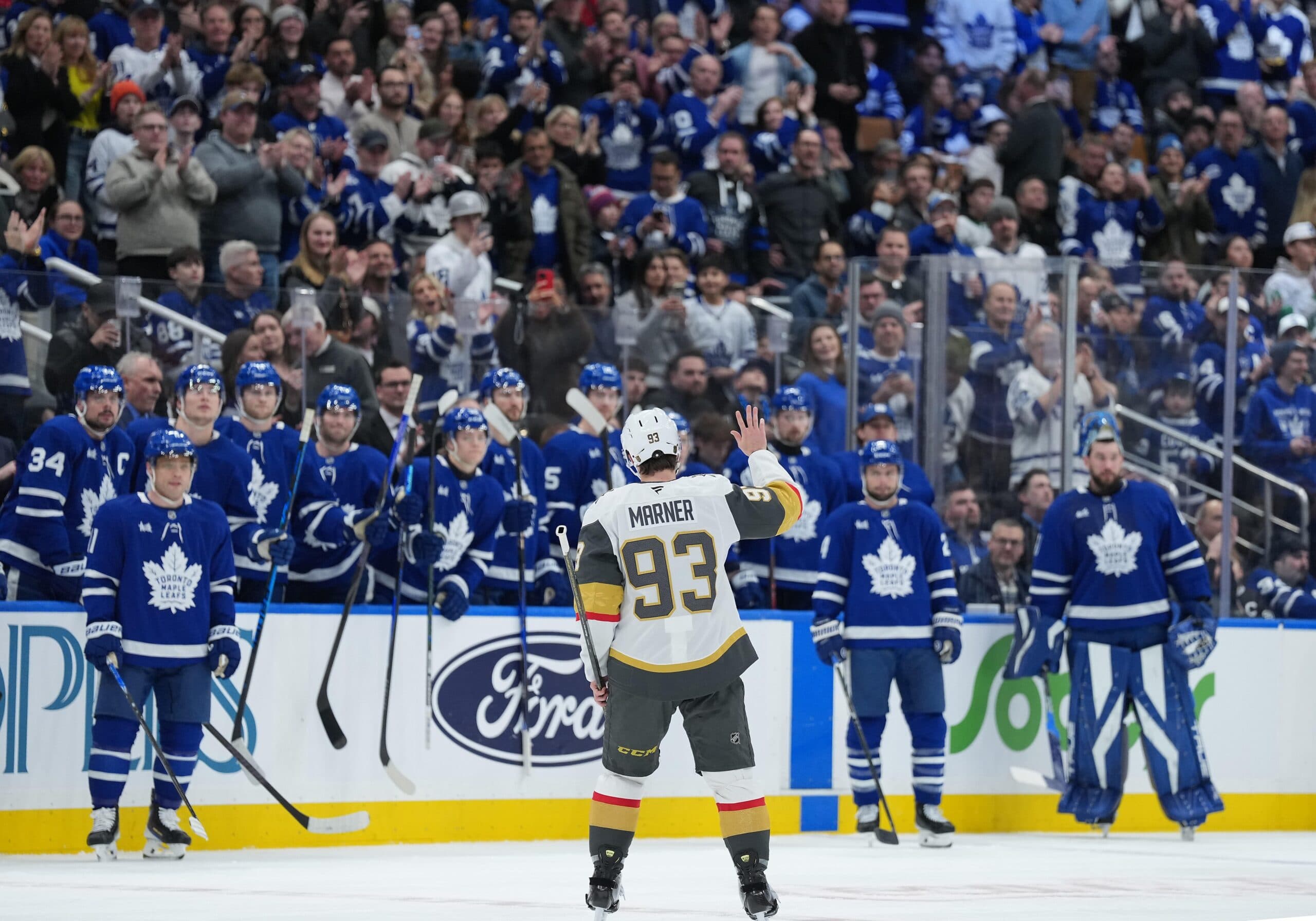
In one week and one day, it will be the 10-year anniversary of the Toronto Maple Leafs winning the first-overall pick in the 2016 NHL Draft, ensuring they can select Auston Matthews.
It was an amazing time to be a Leafs fan because a rebuild that had already accumulated high-end prospects like William Nylander and Mitch Marner was getting the franchise piece it needed, and Toronto would be set for contention soon. It felt like a matter of when, not if, the Leafs would win the Stanley Cup.
But 10 years later, the Leafs have finished in the bottom five for the first time since 2016, and ended a nine-year playoff streak, their longest in the post-Original Six era. And what do they have to show for it? No Stanley Cups, two series wins, and a plethora of traumatizing Game 7 losses. It feels like a worst-case scenario for this core, but in typical Leafs fashion, it’s exactly what happened.
So, as the Leafs near a hiring for the fourth general manager since the 2016 draft lottery and are set to begin a new era as they find a path back to contention, let’s reflect on the 10 biggest mistakes of the last 10 years that have led the team to this point:
10. Trading Nazem Kadri
Some may be surprised to see the Kadri trade leading off this list. It’s often cited as one of the biggest blunders of the last 10 years, particularly during Kyle Dubas’ tenure with the Leafs. Kadri was a staple on the Leafs, as he had the scoring and physical prowess needed for the playoffs, and he gave the team elite center depth behind Matthews and eventually John Tavares. After his departure, the Leafs never really found another solid third-line center, never mind one of Kadri’s calibre.
However, at the time, it was an understandable move. Kadri was coming off a back-to-back playoff runs where he was suspended due to sloppy hits, and it became a question of “would he do it again?”. Dubas was also looking to address the team’s blueline depth while still bringing in a solid third-line center to replace Kadri, and thought he did so by acquiring 59-point scorer Tyson Barrie and 25-year-old Alex Kerfoot.
But it didn’t work out. Barrie lasted one season before the Leafs eventually addressed their defensive concerns with T.J. Brodie, and Kerfoot was solid but never overly impactful, especially in the playoffs (four goals and 13 points in 30 games). Meanwhile, Kadri learned from his mistakes (after one more suspension) and won a Stanley Cup with the Colorado Avalanche. The end result was horrible for the Leafs, but the fact that there’s some logic behind the move puts it lower on this list.
9. Letting Zach Hyman walk
This is another placement that might be controversial for not being placed higher, as some consider it the biggest mistake of the Matthews era. While I think it was a move that clearly aged poorly, I don’t think it was as big a mistake as some fans would make it out to be.
The primary reason is the context at the time. Hyman was 29 years old and had missed 30 games over his final two seasons as a Leaf with lower-body injuries, notably an MCL injury during the 2021 Stanley Cup Playoffs. Those UFA scenarios rarely age well, especially when signed to long-term contracts. For Hyman, it has, but he’s the exception, not the rule. For every Hyman, there’s a David Clarkson, Justin Abdelkader and Andrew Ladd, among countless others.
There are also a couple of other arguments surrounding his departure, which are slightly flawed. Some argue that what Hyman has become with the Edmonton Oilers showcases how badly Toronto screwed up. I’d argue he’s better away from the Leafs for a reason, particularly because his skillset works better with someone like Connor McDavid than it did alongside Matthews and Marner. Hyman wasn’t scoring 54 goals or 16 playoff goals on Matthews’ wing.
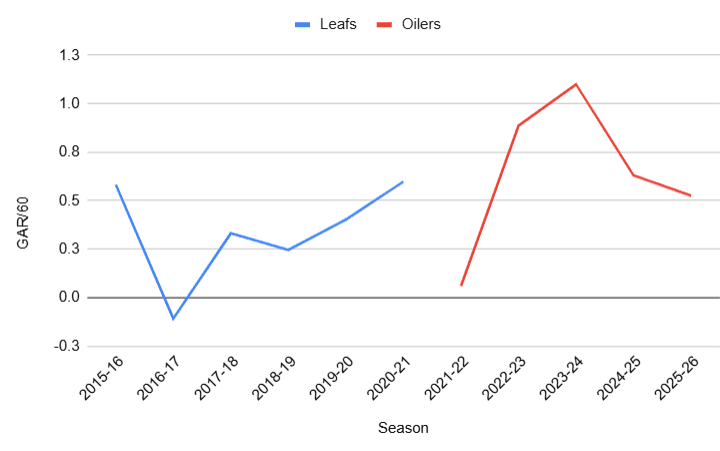
Some also argue the Leafs haven’t been able to replace Hyman since he left, but Michael Bunting and Matthew Knies have more than adequately filled his role in the five years since his departure. In fact, for all the talk about how they need players like Hyman in the playoffs, Knies scored as many goals during the Leafs’ 2025 playoff run as Hyman did in his Leafs career (five), and has a higher playoff goals per game (0.3) and points per game (0.52) than Hyman did (0.16, 0.41).
Don’t get me wrong, this was still a terrible decision. It shouldn’t be a choice of Hyman or Knies. Both should be on the wings of the core four in a perfect world. However, the way Leafs fans talk about this decision, it was as if they got rid of Wendel Clark. But Hyman was never that with the Leafs.
8. Mason Marchment trade
With Kadri and Hyman, you can at least make the case we know of their impact on the Leafs, and how it didn’t result in Stanley Cups. But in the case of Mason Marchment, there’s a much bigger “unknown” factor with what his impact on the Leafs could have been.
Some might forget Marchment was a Leaf, but he was a member of the organization for five seasons after signing an AHL contract out of the OHL. It took him three years to sign an NHL deal and four to make his NHL debut, during which he played four games for the Leafs. But before the 2020 trade deadline, the Leafs shipped him to the Florida Panthers for Denis Malgin.
We all know what happened next. Malgin only played 31 games for the Leafs, while Marchment has gone on to play over 400 games between the regular season and playoffs. His 11 goals and 19 points in 58 playoff games suggest he wouldn’t have had the biggest impact on the Leafs, but who knows how things would have changed if he played alongside two of the Leafs’ four star players. Maybe he could have been a Hyman replacement!
7. Signing Patrick Marleau
There are several reasons why Marleau’s signing with the Leafs caused issues. For starters, there’s the immediate impact. The Leafs were only just beginning their contention window, but signing Marleau forced them to take another step forward, one which they weren’t quite ready for in hindsight. Adding in the Leafs needing to maximize those first three years while Matthews, Marner, and Nylander were on their entry-level contracts, wasting $6.25 million on an aging Marleau wasn’t the right choice.
Then there was the decision to get rid of Marleau’s contract. After two years, the Leafs needed cap space as their core’s second contracts came in, and he still had one more year left on his deal (fun fact: Marleau signed with the Leafs because Lamoriello offered three years while other teams only offered two). As a 35+ contract, a buyout would still provide the same cap hit. In order to get rid of the money, the Leafs had to give up a first-round pick to the Carolina Hurricanes, a pick that eventually became Seth Jarvis. The Leafs sure could have used a guy like him, right? They did get a pick two selections later thanks to trading Kasperi Kapanen, but Toronto selected Rodion Amirov, who did not get the chance to play out his career as he tragically passed away to cancer.
Plus, you could also connect some dots regarding the impact on the core. Was a player from the San Jose Sharks, a team notorious for choking in the playoffs and not winning a Stanley Cup, the right veteran for the young core to learn around? Did Marleau’s habits of signing short-term contracts to maximize his earnings rub off on the core, particularly Matthews? These are purely speculative, but it wouldn’t be outrageous for these to have an impact, either.
6. “We can and we will”
Speaking of impacting contracts, “We can, and we will” refers to, of course, Dubas’ words when asked about re-signing Matthews, Marner, and Nylander after signing Tavares to his $11 million AAV deal. Those words alone created a domino effect on the next year of the Leafs.
It created the pressure for Dubas to sign all three players and get them done at reasonable deals. It led to him playing hardball with Nylander, taking him to the final day of RFA negotiations before signing him to the reasonable ask he had (reportedly) asked for from the start. Then, while trying to avoid the same situation, Dubas went too easy on Matthews and Marner, giving them deals above their RFA peers.
As a result, the Leafs had almost $40.5 million tied up in their four players, which limited the improvements they could make going forward. Now, Dubas made these moves under the assumption of a rising salary cap, which the COVID-19 pandemic effectively stagnated, so the long-term effects weren’t entirely the Leafs’ fault (hence why this is lower than the remaining options). And the contracts weren’t bad by any means. But when you look at the long-term problems of the Leafs, the salary cap was one of them. You have to wonder how the past 10 years play out if they can get their core signed to better deals.
5. Hiring Brad Treliving & Craig Berube
Even though Treliving and Berube were two separate hirings in two separate summers, they need to be bunched in here due to the collective impact the two had. There was a drastic decline in the team’s quality as both entered the organization, transforming the team from a perennial Cup contender to a lottery contender. Playoff failures aside, prior to Treliving joining the team, the Leafs were third in the league in points percentage (.638) from 2016-17 to 2022-23 (behind division rivals in the Boston Bruins and Tampa Bay Lightning, of course), and were fifth in 5v5 expected goal share (52.93%). After Treliving was hired, they were tied for 11th (.585) and 19th (49.13%) in those stats.
When it was just Treliving, the signs of regression were already there. The Leafs’ research and development was clearly ignored in a lot of decision-making, as was the sports science department in the case of players like John Klingberg and Ryan Reaves. “Why?” was a pretty common question to ask when Treliving made a trade or signing. However, Sheldon Keefe’s systems at least allowed the Leafs’ stars to remain effective in carrying the load, most notably Matthews with his 69-goal season.
But once Berube entered the fold, everything took a steeper decline. His defense-first, dump-and-chase, grinding system was one of the core just never quite gelled with, as seen with Matthews’ sharp decline in scoring. And despite preaching defense first, Berube’s systems actually saw them get worse defensively, as they dropped from 2.41 5v5 expected goals against per 60 (tied for eighth) in five seasons under Keefe to 2.75 (tied for 20th) in two seasons under Berube. I broke it down at the time of Treliving’s firing, but both the GM and coach failed to capitalize on the Leafs’ prime years, propelling them backward instead.
4. Failure to acquire impact depth players
The star players in Toronto get a lot of the attention for their inability to perform in the playoffs, but the depth players shouldn’t escape criticism either. If anything, their depth players’ lack of performance made it easier for opposing teams to stifle the Leafs’ stars and limit their overall offense down the stretch in a series.
Over the entirety of Toronto’s nine-year playoff streak, only three players outside of Matthews, Marner, Nylander, Tavares, and Rielly had more than FIVE goals in the playoffs: Knies (eight), Hyman, and James van Riemsdyk (both five). If you want to go off goals per game, only van Riemsdyk (0.38), Tyler Bozak (0.31), and Knies (0.3) averaged more than 0.3 in the playoffs. The Leafs rarely generated offense from their supporting cast, including “playoff performers” like Hyman and Kadri.
Management also didn’t do a great job of acquiring secondary scoring options beyond the core four. Some of that was because of the lack of salary cap space, but management also struggled to pick the right targets at trade deadlines (like spending a first-round pick for Nick Foligno when Taylor Hall went for a second and a depth player at the same deadline), and most notably, choosing to protect Justin Holl over Jared McCann for the Seattle Kraken expansion draft.
Add in Dubas’ love for acquiring “cardio merchants” (players who drove play but not chances), and Lamoriello and Treliving’s love for veterans and tough guys who were consistently outplayed, and with the Leafs never built a proper team around the core players. But there’s another underlying issue here.
3. Mark Hunter’s draft record
This is technically cheating, because some of this falls before the Leafs drafted Matthews. But it set the tone for the Leafs’ struggles to build around their core players. Hunter oversaw three drafts for the Leafs in 2015, 2016, and 2017, with the 2015 and 2016 drafts being essential for building the support system beyond the foundation of Matthews, Marner, and Nylander. They had 20 picks in those two drafts alone, along with seven in 2017.
The end result? Beyond the first-round picks of Marner, Matthews, and Timothy Liljegren, the three drafts produced only three players who became NHL regulars: Travis Dermott, Carl Grundstrom, and Joseph Woll. Three out of 24 picks, a success rate of 12.5%. Dubas wasn’t much better, going six for 33 (18.18%), but you could also argue that another four (Dennis Hildeby, Nick Abruzzese, Artur Akhtyamov, William Villeneuve) can still establish themselves as regulars. Heck, Dave Nonis went four for nine in his two drafts as GM (Carter Verhaeghe, Dakota Joshua, Pierre Engvall, Andreas Johnsson).
As a result, the Leafs lacked younger talent to truly support the core players and provide a deeper group in the playoffs. They needed those young players on ELCs with how much cap space was invested in their core, and while some came along in Knies, Nick Robertson, and Pontus Holmberg, they were few and far between. Dubas was at least able to make up for it by finding cheap talent in free agency, but the last 10 years probably would have gone much differently if Hunter had hit on a few more of those draft picks (especially when Sebastian Aho, Kirill Kaprizov, Alex DeBrincat, Adam Fox, Jesper Bratt, Robert Thomas, Jeremy Swayman, and many more were available at some picks).
2. The 2025 trade deadline
There are a lot of moves on this list that could be considered death by a thousand cuts, but the 2025 trade deadline was the death blow. The Leafs appeared to be a contender in 2024-25, as they were in the running for the Atlantic Division title (which they eventually won), but anyone who paid attention knew the team was a paper tiger. Regardless, Treliving and Berube were confident in the team and decided to go all in.
What did all-in look like? The Leafs dealt multiple first-round picks and a couple of prospects who had shown NHL value for Scott Laughton and Brandon Carlo. The Laughton trade wasn’t great, especially when the Leafs mostly used him as a fourth-line center before dealing him to the Los Angeles Kings a year later. But the worst move was the Carlo trade, as they brought in a declining defenseman mostly used in a bottom-pair role with the Bruins for a first and Fraser Minten. The first wasn’t originally viewed to be one of consequence, but with how the 2025-26 season went, the upcoming lottery results will now be the difference between the Leafs picking in the top five and the Bruins getting the sixth-overall pick.
As a result, the Leafs find themselves in a position where they failed to make the playoffs this season and could potentially miss again in the next year or two, all while having to give up two first-round picks in the next three drafts. It basically forces their hands towards a retool without the tools to do so, as they can’t properly rebuild without a top pick, nor can they risk falling so low that the Philadelphia Flyers or the Bruins get a high pick.
With it feeling like it may only delay the inevitable rebuild, it’s quite likely the aftermath of those trades has ended any chance of Matthews, Nylander and Tavares winning a Stanley Cup with the Leafs.
1. Losing Mitch Marner for (almost) nothing
Whether you were in favour of moving on from one of the Leafs’ core players to shake up the team, or you wanted to keep the gang together in hopes they finally get their shot similar to Alex Ovechkin and the Washington Capitals in 2018, I think both sides can agree the end result with Marner went about as poorly as it possibly could. There was a right way to move on from a piece or two of the core, but leaving it to the point where the decision was up to one of the players and not the team themselves was the worst way.
We will never know the full story of when the Leafs tried to move on from one of the core players, but there were certainly times when they should have. It could have been done in 2021 after the disappointing collapse against the Montreal Canadiens. It could have been done in 2023 before Matthews, Marner and Nylander’s no-move clauses kicked in, significantly complicating that process. But it definitely shouldn’t have been left until 2025, as the Leafs lost one of their star players (playoff performer or not) for almost nothing.
Yes, they did get Nicholas Roy from the Vegas Golden Knights for Marner, who they then dealt for the Avalanche’s 2027 first-round pick, so maybe the Leafs draft a player who can make up the difference there. And they did try to get ahead of that situation and send Marner to the Hurricanes for Mikko Rantanen. But that’s where not doing it before the NMCs kicked in became a problem, as Marner nixed the deal. The Leafs left that option far too late and were burned as a result, getting almost nothing in return for a superstar two-way winger. And now with nothing to show for it, the team has struggled to replace his value, even in the aggregate.
CHECK OUT OFF THE ROSTER – NEW EPISODES EVERY WEEKDAY
Off The Roster is Toronto sports. Hosted by Cabbie Richards, Lindsay Dunn, and Dan Riccio, this is the go-to morning conversation for everything happening in the 6ix – Hockey, Baseball, Basketball and everything in between. From breakout performances and questionable trades to throwback jerseys, viral moments, and the stories fans are actually talking about – it’s smart, sharp, and never scripted. Live weekday mornings on the Nation Network YouTube channel and available wherever you stream podcasts, the show delivers real opinions, real chemistry, and real Toronto energy. Missed an episode? Catch up anytime. Off The Roster—The new sound of the 6ix.
Recently by Scott Maxwell
- Which NHL veterans are most deserving of their first Stanley Cup?
- Breaking down every Round 1 goaltending matchup in the 2026 Stanley Cup Playoffs
- What’s next for Sergei Bobrovsky?
- Which NHL teams look like 2026 Stanley Cup contenders right now?
- Fumbling the Leafs’ prime contention window was Brad Treliving’s biggest failure