Why Blackhawks need to be 2026 NHL offseason’s most aggressive team

“The Chicago Blackhawks eagerly anticipate the upcoming NHL Draft Lottery, after which they’ll be picking in the top five no matter what…”
…is a sentence we could’ve written in 2026, 2025, 2024, or 2023. The Blackhawks haven’t made the Stanley Cup playoffs since 2017, save for their 2020 “berth” when they were gifted a COVID bubble spot after finishing 23rd overall and upset the Edmonton Oilers during the play-in round. Since their last honest playoff year of 2016-17, the Hawks have picked in the first round of the draft 17 times, including four top-three selections. Yet here they are, fresh off a third consecutive season finishing with the league’s second-worst record, ready to add yet another top-end prospect to their bursting pool.
It’s fair to wonder what GM Kyle Davidson has done to warrant the multi-year extension the team announced for him earlier this month. He’s held the position since 2022 and hasn’t overseen any meaningful progress in the standings; he’s also cycled through four head coaches over that span in Derek King, Luke Richardson, Anders Sorensen and Jeff Blashill. Why is it that Davidson has earned years of additional runway in the job, let alone keeping the job at all?
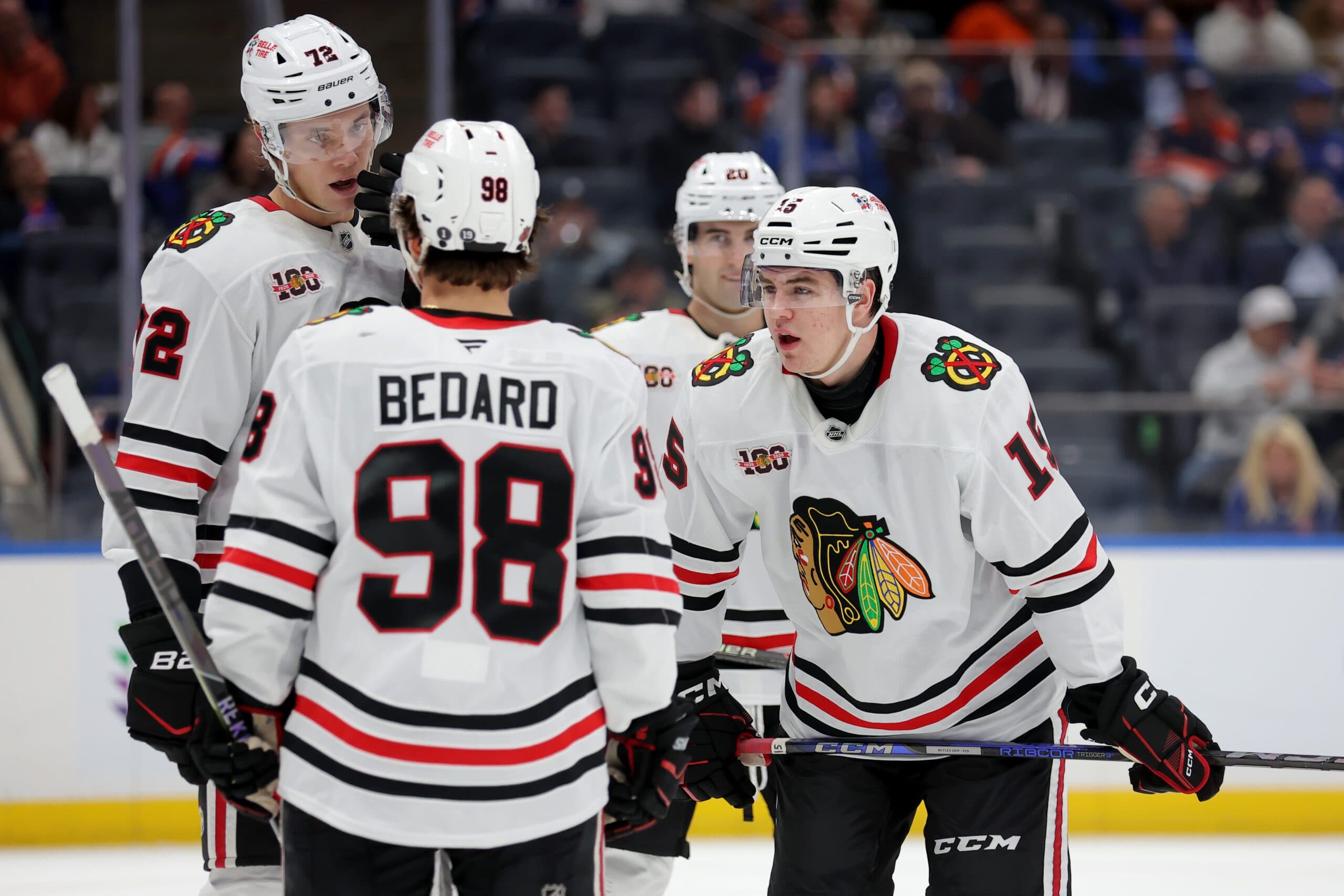
Perhaps ownership is projecting out the next few seasons, understanding that this team has built an impressive critical mass of young talent over the past several drafts in particular. The Hawks have an exciting young superstar on the rise in center Connor Bedard, who, on a per-game basis, took a meaningful step toward realizing his generational-talent ceiling this season. They have a fifty-mitted middle-six center in Frank Nazar; a pair of towering, mobile defensemen with long-term minute-muncher ability and upside for much more in Artyom Levshunov and Sam Rinzel; and a stud of a goaltender signed to a long-term deal in Spencer Knight. Late this season, they broke in 18-year-old Anton Frondell, a two-way stud of a center who will be a Calder Trophy frontrunner next season. They’re also likely to import sniping winger Roman Kantserov for 2026-27 after he led the KHL in goals during the final season of his contract there. And that says nothing of additional top-end prospects in the fold, from speedy two-way pivot Oliver Moore at the NHL level to goal-scoring winger Marek Vanacker in major junior and many more.
At the same time: Nazar hasn’t evolved enough yet to justify the seven year, $6.59-million AAV extension he inked last summer. Kevin Korchinski, taken seventh overall in Davidson’s first draft as GM in 2022, is trending toward bust status, having spent most of the past two seasons with AHL Rockford. Rewind the development pipeline further and you see a litany of first-round whiffs who are no longer even with the organization: Nolan Allan in 2021, Lukas Reichel in 2020, Adam Boqvist in 2018. Developing young talent hasn’t been easy for the Blackhawks – Levshunov, taken second overall in 2024, struggled quite a bit this season, too – so the organization can’t simply assume all its blue-chippers will magically form a contender. We’ve seen plenty of franchises in recent NHL history struggle living up to the prospects-equal-future-juggernaut label, from the Buffalo Sabres of 2011-2025 to the Arizona Coyotes pre-Utah move. At some point, impactful veterans must be brought in to complement the kids.
And the Hawks have been highly conservative in doing so during the Davidson era, presumably in hopes of preserving the tank and keeping the team from rising to the dreaded murky middle. They’ve hit on a Tyler Bertuzzi here, a Ryan Donato there, but they’ve been careful not to commit big money and especially big term to many veterans, adding bodies only with short commitments remaining as part of cap-dump trades, such as Andre Burakovsky and Ilya Mikheyev. They’ve been rewarded for that strategy in the form of continued losing and a gushing faucet of top-three draft picks. But there comes a point when an organization has too many prospects to fit them all in the lineup long-term; that’s when it’s time to throttle up and start actively pursuing upgrades. Examples: Buffalo trading Matt Savoie for immediate help in Ryan McLeod (wink, wink) and the Utah Mammoth moving Conor Geekie in the Mikhail Sergachev trade.
Behold: Chicago’s current salary-cap breakdown. Per PuckPedia, they have a whopping $40.243 million in projected cap space for 2026-27, when the cap rises to $104 million. They’ll devote at least a quarter of that to the AAV on Bedard’s extension, as he’s a 2026 restricted free agent, but that leaves a significant amount of spending cash, and it’s time to be aggressive with it.
A piece of wisdom from an active, Stanley Cup-winning GM that has always stuck with me: “Championships in the cap era are won with entry-level contracts.” What he meant: you want to take a swing while some of your top young players haven’t reached their second deals and massive pay days. It’s too late for Bedard and Nazar and steady blueliner Alex Vlasic, but that’s not the case for Frondell, Kantserov, Rinzel or Levshunov. The Blackhawks of summer 2009 recognized that principle when they signed Marian Hossa to a long-term deal before Patrick Kane and Jonathan Toews completed their entry-level deals. They won the first of three Stanley Cups in that era with Kane and Toews on cap hits south of $900,000.
The problem: there’s no Hossa to chase this time, as the 2026 unrestricted free-agent board has already been decimated. From Connor McDavid to Kirill Kaprizov to Jack Eichel to Kyle Connor to Artemi Panarin to Adrian Kempe, seemingly every top dog re-signed before going to market, a symptom of the rising-cap world in which players don’t get squeezed out of their teams’ price ranges as easily.
Chicago could take a run at the top remaining UFA, Sabres right winger Alex Tuch, or breakout Tampa Bay Lightning defenseman Darren Raddysh, and they have the cap space to overpay and win a bidding war, but Davidson also needs to consider the trade route. He’s in an advantageous position with a prospect pool so incredibly deep that his 10th-best youngster might be a top prospect on several other NHL teams. You can spare a Moore or a Sacha Boisvert, for instance, when Frondell and probably Kantserov project to be fixtures next season and beyond. The Hawks also have three second-round selections in the 2026 Draft on top of their first, plus three firsts in 2027. They are excellently equipped to construct compelling trade packages for teams looking to unload cap space and/or kickstart rebuilds. Heck, if the Hawks drop out of the 2026 Draft’s top two and can’t pick Gavin McKenna or Ivar Stenberg, do they consider dangling the pick to another team if it’s third or fourth overall? What if that gets you a Vincent Trocheck or an Elias Pettersson, for instance? What if you combine a pile of assets in hopes of a bigger swing at a Brady Tkachuk or an Auston Matthews?
Calm down, Leafs and Sens fans, those are merely extreme examples to illustrate that Chicago’s possibilities are endless. They have the cap space and the pick and prospect capital to be players for any free agent, any big-name player on the trade block, and it’s imperative that they behave aggressively with their war chest this summer. By 2027-28, Levshunov and Rinzel’s next contracts will be on the books, with Frondell’s the year after that. The time to attack is right now.
Maybe Chicago ownership has kept Davidson around knowing this was the plan all along, that the franchise would take a dive for several seasons before finally starting to push. But it’s up to him to justify their faith, and it has to start happening this summer.
_____
CHECK OUT OFF THE ROSTER – NEW EPISODES EVERY WEEKDAY
Off The Roster is Toronto sports. Hosted by Cabbie Richards, Lindsay Dunn, and Dan Riccio, this is the go-to morning conversation for everything happening in the 6ix – Hockey, Baseball, Basketball and everything in between. From breakout performances and questionable trades to throwback jerseys, viral moments, and the stories fans are actually talking about – it’s smart, sharp, and never scripted. Live weekday mornings on the Nation Network YouTube channel and available wherever you stream podcasts, the show delivers real opinions, real chemistry, and real Toronto energy. Missed an episode? Catch up anytime. Off The Roster—The new sound of the 6ix.
_____