The five biggest blowouts in international hockey history

International hockey still has a long way to go to reach max parity. But, truthfully, there has never been a more competitive time to keep an eye on the global stage than right now.
A total of 60 teams (including the currently banned Russia and Belarus) are ranked in the latest IIHF men’s rankings, published last spring. There are another 45 teams on the women’s side, up from just 26 when the IIHF introduced the ranking system back in 2003.
As the game continues to grow globally, the competition has gotten significantly closer, too. For example, Canada won its 18th gold medal at the Men’s World Championship in 1959. Over the past 66 years, Canada has won just 10 more, which still makes them the most dominant team in tournament history. Only the Soviet Union/Russia have managed to register more than 20 gold medals, sitting one behind Canada at 27.
In that time, we’ve seen Sweden and Finland establish themselves as IIHF powerhouses on the men’s side. Switzerland has become a perennial gold medal favorite, while Germany has played in the medal round twice in the past five years. Latvia took home its first major medal of any kind back in 2023, and Denmark qualified for the final four for the first time back in 2025 after shocking Canada in the quarterfinal.
For reference, Canada once beat Denmark 47-0 at the 1949 World Championship. Denmark beat the Canadians 2-1 last year. The days of the biggest programs steamrolling just about everyone en route to the medal round are over now, and it’s great for the sport.
Just for fun, here’s a look at the biggest victories by the six teams with the most gold medals in Men’s World Championship history:
- Canada beat Denmark 47-0, 1949 World Championship
- Czechoslovakia/Czechia beat Yugoslavia 24-0, 1939 World Championship
- Finland beat Norway 20-1, 1947 World Championship
- Russia/Soviet Union beat Italy 28-2, 1967 World Championship
- Sweden beat Belgium 24-1, 1947 World Championship
- United States beat Italy 31-1, 1948 World Championship
See? Nothing recent. International hockey is in a good spot right now across most levels. There’s still a ton of work to make the product truly enjoyable every single day. But there’s no question the game has never been more competitive than it is right now.
But today, we’re looking back at five of the biggest blowouts in international hockey history. You’ll never see scores like this in the NHL. But history has proven to us that there can be some significant disparity on the world stage, especially at the lower levels where many players don’t get to play competitive hockey until the World Championship.
Let’s have some fun (or, at least a bit more than the teams on the losing end of the spectrum):
5. 57-0: Thailand vs. Kuwait (2024 U-18 Asian and Oceania Championship)
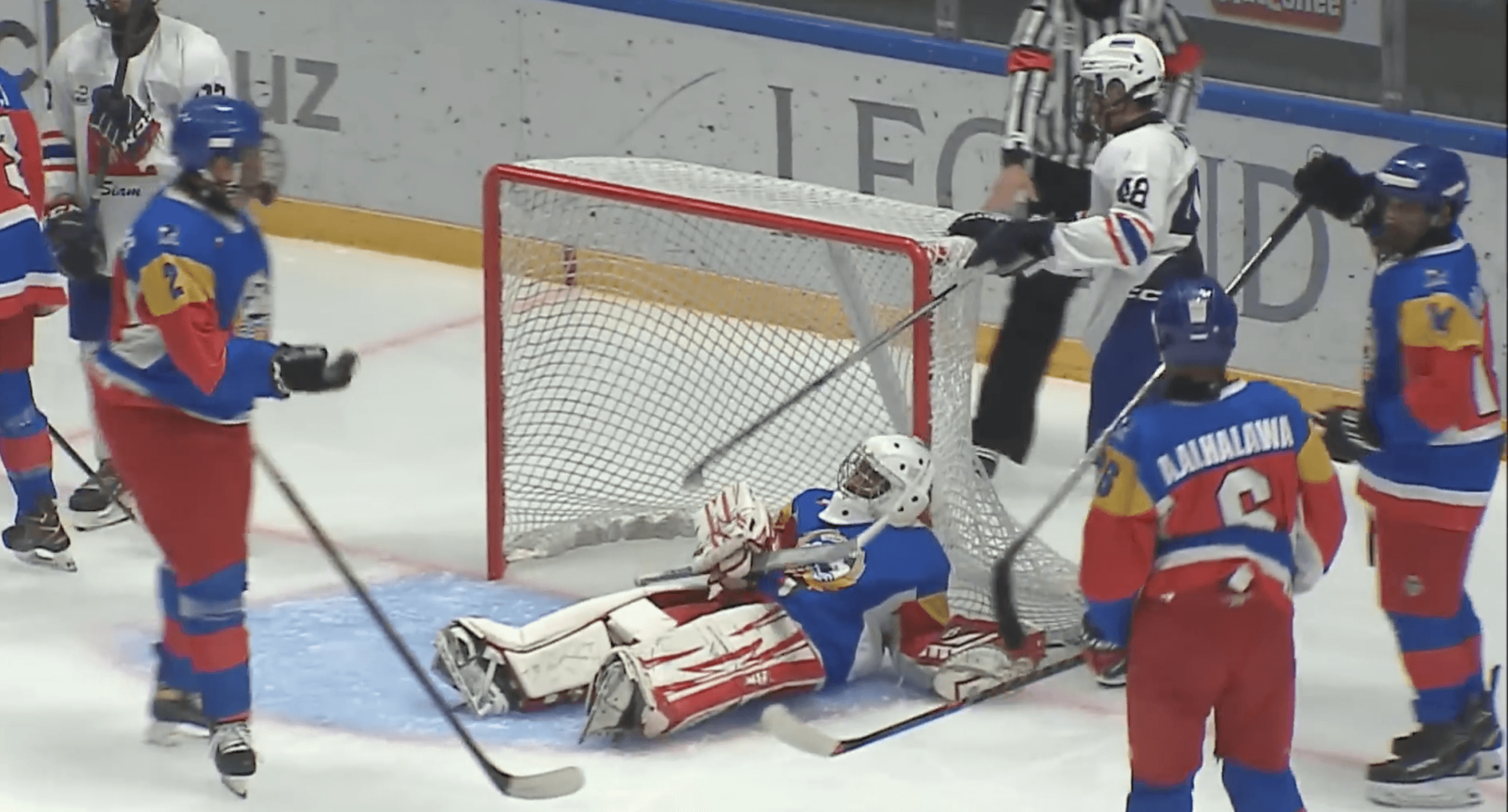
This is the most recent outing to get on this list – and, honestly, it was a crazy team, all things considered. Uzbekistan, Thailand, Kuwait, India, Indonesia, Iran, Macau, Malaysia, Mongolia and the United Arab Emirates made up the two groups, with Kuwait, in particular, making its U-18 tournament debut. Nobody expected much, but a 57-0 loss is about as ugly as it gets.
Thailand outshot Kuwait 122-1, with Adeeb Alhalawa registering the lone chance on net for Kuwait. Kingston Zi-Jun Pan made the save on the breakaway chance. Six players had double-digit outputs for Thailand, with Natapat Patong leading the way with seven goals and 13 points. He found himself in a three-way tie for the goal lead, sharing it with Natchayatorn Yannakornthanapunt and Thananutch Khultanthorn.
Kuwait lost every game in the tournament and even went home early after forfeiting their match against Uzbekistan, trailing 17-0 after a single period. Wildly, Kuwait didn’t come last – Indonesia was ultimately disqualified for having an ineligible player on their roster. Kuwait’s U-18 team hasn’t competed since, but the senior team sits 47th in the world rankings.
Here’s the 57-0 game if you want to watch it in it’s entirety for some reason:
4. 58–0: Australia vs. New Zealand (1987 World Championship, Group D)
Australia and South Korea were on another planet at the Group D World Championship in 1987, held in Perth, Australia. The Aussies started the tournament with a 37-0 win over Hong Kong. South Korea blasted the Kiwis 35-2 later that same day, too. So Australia – the pre-tournament gold medal favorites – knew they were destined to absolutely destroy their Trans-Tasman neighbors from New Zealand. The IIHF never published a detailed stat breakdown (online records before 2000 are essentially impossible to find), but the game became the highest recorded blowout in a senior men’s national team event at the time – a record that still holds to this day.
The second meeting between the two nations was a bit closer, with Australia winning just 29-0. New Zealand scored twice in both meetings against South Korea, and also blasted Hong Kong 19-0 in both meetings to help finish with 42 goals. A total of 350 goals were scored over 12 games, with Australia and South Korea (thanks to Romania skipping the 1988 Group C tournament) earning promotion for the following year. Scott Davidson and Charles Cooper finished with the tournament lead with 42 points each, while Sandy Gardner finished a point behind after scoring a team-leading 23 goals. The gap between the two nations has shrunk in recent years, with Australia ranked 41st and New Zealand 45th.
3. 63-0: Kazakhstan vs. Iceland (1998 European U-18 World Championship, Group D)
This is the event that helped put Nikolai Antropov on the map. Kazakhstan was the clear favorite in an event that also included Bulgaria, Israel, Luxembourg, Spain, and the Netherlands. Antropov finished the five-game stretch with an incredible 54 points, while the Kazakhs outscored their opponents 155-4 overall. There wasn’t a single competitive game involving the Kazakhs, who would earn promotion to a higher pool for the 1999 edition while finishing fifth.
An official scoresheet isn’t available for this game, but it was clear that Kazakhstan simply was miles ahead of everyone in their group. Antropov finished the tournament with 23 goals and 31 assists, the second-highest-scoring player, while Rustam Yesirkenov finished with 35 points. The top scorer outside of Kazakhstan was Belgium’s Wesley Serneels, who had 14 goals and 17 points in five games. That alone would have been enough for the MVP title at most other IIHF events. Instead, the high-flying Kazakhs made up 14 of the top 16 scorers in the tournament. The IIHF changed the format of the tournament, announcing the start of the IIHF U-18 World Championship that features a format more similar to what we see every spring nowadays. Kazakhstan’s senior men’s team is a consistent threat in the top two IIHF World Championships, while Iceland sits 31st.
2. 82-0: Slovakia vs. Bulgaria (2008 Women’s Olympic Qualifiers)
This game was so wild that it got its own Wikipedia entry. Apparently, only 37 people showed up to watch this legendary matchup in Liepāja, Latvia, which currently serves as the largest victory in a senior-level international hockey affair. The Slovaks got off to a 31-0 lead in the opening period, before scoring 24 and 27 goals in the second and third periods, respectively. Forward Maria Herichova led the way with eight goals and 10 assists, while Nikoleta Cerlarova and Martina Velickova had 17 points a piece. Liubomira Shosheva was an absolute trooper for the Bulgarians, stopping 57 of the 134 shots sent her way. Bulgarian coach Roman Morgunov eventually pulled her after the 77th goal, only to have backup Kamelia Draheva allow all five shots sent her way. Bulgaria didn’t register a shot at any point.
For context, Slovakia hadn’t yet established itself as a top-division mainstay, but they were close. At the time, Bulgaria had just 37 registered women’s hockey players, with many too young for the event. That led to one of Bulgaria’s goaltenders playing forward. There was even a fight with 10 seconds left for good measure after Anna Džurňáková slashed Bulgarian forward Tina Lisichkova in the back of the head. Absolute chaos all around – and it even resulted in the Slovak coach calling for the IIHF to help prevent fewer blowouts in the future. Slovakia went on to qualify for the 2010 Winter Olympics thanks to this event, lost to Canada 18-0 (the most lopsided victory in Olympic women’s hockey history) and has yet to return to the big show ever since. Bulgaria is currently the 32nd-ranked team on the women’s side, moving up five spots from 2024.
1. 92-0: South Korea vs. Thailand (1998 IIHF U-18 Asia Oceanic Championship)
Ever heard of Song Dong-hwan, the “Asian Rocket”? He had a modest pro hockey career, winning two Asia League titles and a handful of international medals. But nothing matched his utterly insane run at the 1998 U-18 Asia Oceanic Championship, where he scored 30 of South Korea’s 92 goals in the most lopsided victory we’ve ever seen at any competitive hockey tournament. It was his third run with South Korea at the AJC’s, having registered nine goals combined in the first two runs.
The tournament was… ugly, to say the least. South Korea tied Japan in the final game, resulting in a tie for first place. The Koreans finished the tournament as champions, though, thanks to a goal differential of +144 after just five games. Japan, meanwhile, finished with a measly +127. But that tie was the only close game of the tourney – the opening games didn’t feature a goal differential of fewer than 21. Japan eventually beat Thailand 58-0, but, clearly, they should have considered scoring another 30 in that one. Thailand, unsurprisingly, came last with a -214 goal differential and a 0-5 record, which is what made that monster win over Kuwait so cool. South Korea’s men went on to play at the 2018 Winter Olympics. Thailand, meanwhile, moved up four spots to 36th this past year as a Division IIIA Men’s World Championship squad.
SPONSORED BY bet365
Recent Articles by Steven Ellis
- 2026 NHL Mock Draft: Post-draft lottery top 32
- How IIHF World Championship rules differ from the NHL
- Jakub Dobes’ ability to bounce back could save the Canadiens
- Sabres’ Zach Benson is the perfect blueprint for what a smaller NHLer should be
- Breaking down the Canucks’ options at the 2026 NHL Draft
- Sharks have big decision to make with No. 2 pick in 2026 NHL Draft
- What Gavin McKenna offers the Toronto Maple Leafs