Why the Yzerplan failed in Detroit — and where the Red Wings go from here

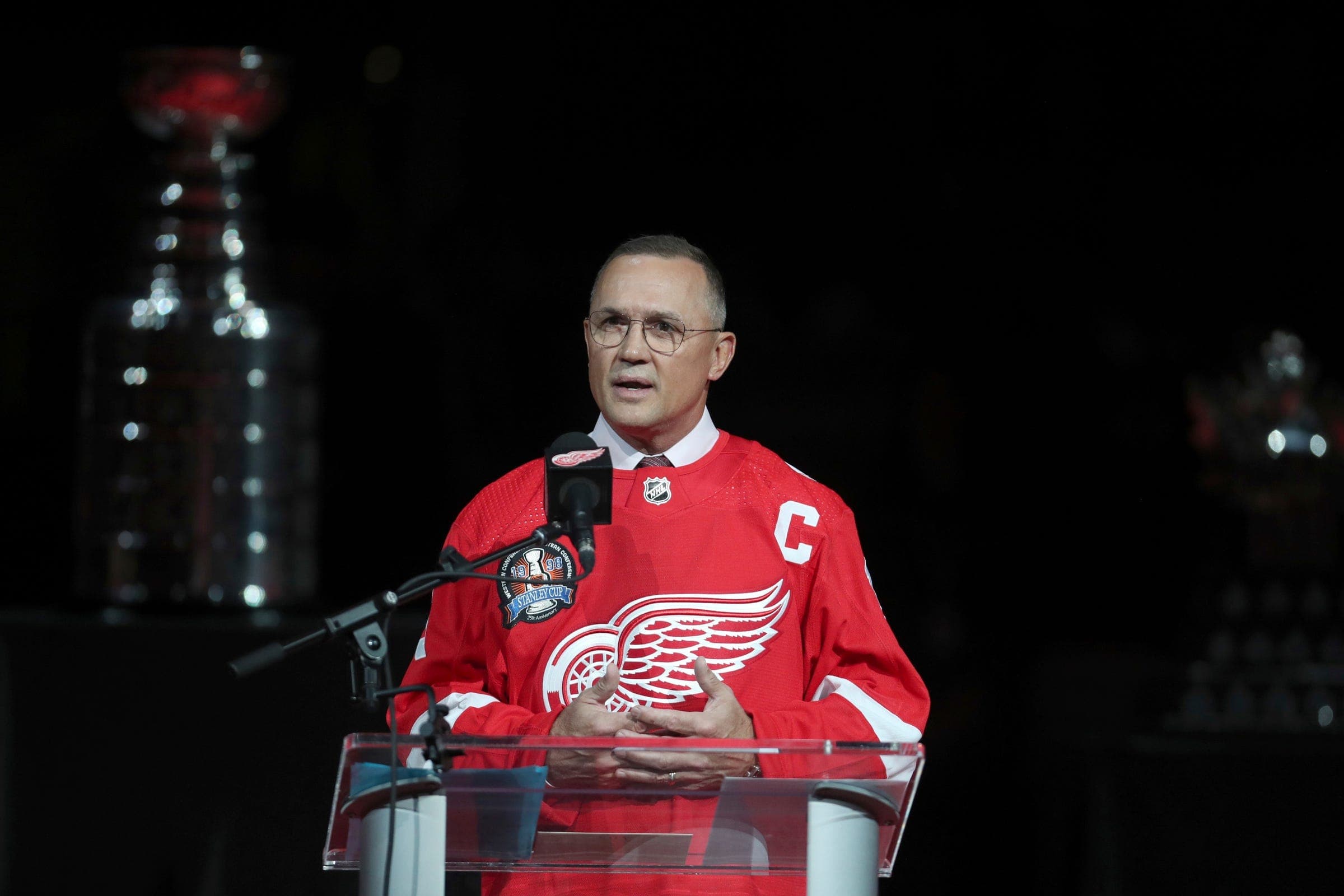
After spending seven seasons in control of the hockey operations side of the Detroit Red Wings, Steve Yzerman’s tenure as the club’s GM and executive vice president came to an abrupt end on Wednesday morning.
It’d be an understatement to say it was an odd time to make a change. After all, it’s been more than three months since the Red Wings were officially eliminated from 2026 playoff contention, and six weeks since captain Dylan Larkin’s trade request became public knowledge. Nevertheless, Yzerman was allowed to guide the Red Wings through the 2026 NHL Draft and the start of unrestricted free agency before “stepping down.”
Whether Yzerman actually chose to vacate his roles with the Red Wings, or if he merely acquiesced to pressures from above and chose to save face, the outcome is the same. The ‘Yzerplan,’ the term Detroit faithful first used as a rallying cry to describe Yzerman’s attempt to change the Red Wings’ fortunes but that ultimately became something of a pejorative near the end of his tenure, is no more.
The Red Wings are the sixth NHL club to change general managers in the wake of the 2025-26 campaign, but the only one to do so after most of the major offseason work has already been done. Since the Red Wings played their last game, Yzerman has signed Viktor Arvidsson, acquired Keegan Kolesar and traded away top goalie prospect Sebastian Cossa for a first-round pick he used to draft J.P. Hurlbert. All perfectly reasonable moves in their own way, but again — why was he the one who got to make them?
Red Wings fans have waited a long time — first with remarkable patience and restraint, but now with understandable restlessness — for the early promise of Yzerman’s tenure to be fulfilled in any meaningful way. But after years of bad bets in unrestricted free agency, ill-conceived trade acquisitions and puzzling drafting, it became clear that the situation in Detroit just wasn’t getting any better, no matter how many fans continued to hold out hope that Yzerman would eventually come out on top.
At first, it was understandable. During his time as GM of the Tampa Bay Lightning, Yzerman cultivated a reputation as an executive with an unerring long-term vision for his team. With the Bolts, he made plenty of decisions that looked questionable at the time, like when he held onto Jonathan Drouin for more than a year after he requested a trade — only to end up flipping him for Mikhail Sergachev, who played an integral role in Tampa Bay’s 2020 and 2021 Stanley Cup championships.
Yzerman began his Red Wings managerial tenure in similar fashion, shocking most analysts by taking Moritz Seider with the No. 6 overall pick in the 2019 NHL Draft. That decision proved to be an excellent one, as Seider promptly developed into Detroit’s top defenseman — only reinforcing the notion that when Yzerman went against the grain, he always had a good reason.
But in the end, the biggest difference between Yzerman’s two GM tenures is that he didn’t inherit two lottery picks in Detroit. Under his purview, the Red Wings simply weren’t bad enough for long enough, and they never had any lottery luck. Conversely, when he took over as GM of the Lightning in 2010, his predecessors had already drafted Victor Hedman and Steven Stamkos. Yzerman certainly played a huge role in building that Lightning team into a contender, but he also had a big head start.
Under Yzerman, the Red Wings finished last in the league in 2019-20, and while they fell to the No. 4 draft pick via the lottery, they still drafted Lucas Raymond, who would certainly go ahead of Alexis Lafrenière and Quinton Byfield in a re-draft. The following year, they snagged Simon Edvinsson at No. 6, and in 2022, they selected Marco Kasper at No. 8.
Seider, Raymond, Edvinsson, and Kasper — four good young players. But were they enough to make a contender out of a group that previously featured Dylan Larkin and very little else? Not even close, particularly considering that Larkin has always profiled more like a high-end No. 2 center than a true No. 1. But from 2022 onward, the Red Wings perpetually operated in a fashion that suggested they viewed themselves as being on the verge of returning to prominence, and with every shortcut they tried to take, they put themselves even further from their goal.
Yzerman spent himself silly in the 2022 free agency period, handing out $28 million over five years to Andrew Copp and $19 million over four to Ben Chiarot — two of the worst value contracts of the summer. His subsequent signings weren’t much better: J.T. Compher at $25.5 million over five years, Justin Holl for three years at $10.2 million, Chiarot for three more years at an inexplicable total of $11.55 million. On the wings, he handed even more money to past-their-prime veterans in Patrick Kane and Vladimir Tarasenko, both of whom gave up at least as much as they produced while blocking younger players from opportunities next to Larkin and Raymond; in goal, the Red Wings played a seemingly endless game of musical chairs, with Thomas Greiss, Alex Nedeljkovic, Ville Husso, Alex Lyon, and Cam Talbot each getting one year as the starter before being shunted to the backup spot to make room for someone new.
While it would’ve been hard for the Red Wings not to improve from their 17-win 2019-20 season, they still didn’t show nearly enough progression in seven years under Yzerman, never once winning more games than they lost. And as the team continued to tread water, the relationship between Yzerman and Larkin — two of the most popular Red Wings captains in recent memory — became increasingly frosty, with the two sending not-so-subtle jabs at each other through the media. In the wake of yet another late-season collapse (an annual trend) that resulted in the team missing the playoffs in 2024-25, Larkin appeared to blame Yzerman’s inactivity for the team’s regression with his remarks at his end-of-year press conference.
“We didn’t gain any momentum from the Trade Deadline, and guys were kind of down about it,” Larkin said at the time. “It’d be nice to add something and bring a little bit of a spark on the ice.” Yzerman’s response: “I’m counting on our best players, our leaders, to give us a bit of a morale boost. That’s what they’re paid for, and that’s the expectation from them.”
In all fairness, Yzerman had recently made a strong move to bolster his core, acquiring Alex DeBrincat from the Ottawa Senators in the summer of 2023 to ride shotgun with Larkin. The Red Wings paid a pittance to get him, particularly compared to what Ottawa gave up for him the previous year, and Yzerman very reasonably banked on DeBrincat, Larkin, and Raymond being able to lead the rest of the team’s forward group together. Unfortunately, Yzerman was unable to build anything resembling a playoff-level supporting cast, and aside from the DeBrincat deal, he never managed to parlay first-round picks into legitimate core pieces over the second half of his GM tenure.
The nadir of that trend came this past season, when Yzerman traded a package headlined by an unprotected 2026 first-round pick in exchange for 34-year-old Justin Faulk, who did not move the needle one bit for the Red Wings during yet another unsuccessful stretch drive. But in the years prior, Yzerman elected to hold onto most of his top draft picks. Instead of trying to replicate his successful DeBrincat trade, Yzerman used his first-rounders (nearly all of which fell near the middle of the draft order) on Nate Danielson, Axel Sandin Pellikka, Michael Brandsegg-Nygard, and Carter Bear, all while his hand-picked coaching staff continued to deploy the likes of Copp, Compher, Kane, and Chiarot in prominent roles.
Trading picks and prospects for an aging Faulk was clearly the wrong move at the wrong time for this team. Likewise, would the Red Wings not have been much better served by investing some of their formidable draft capital into meaningful roster upgrades on the right side of 30, preferably in the years before Larkin reached that age? Alas, here we are now, with Larkin set to exit his 20s on the penultimate day of this month — and while the Waterford, Mich. product still has five years left on his contract, that didn’t stop him from asking to be moved away from his hometown team. What a disaster.
The Red Wings have missed the playoffs in each of the last 10 seasons, which now qualifies as the longest active drought in the NHL. Yzerman is no longer at the controls, and it remains to be seen whether that impacts Larkin’s trade request. As established, the NHL’s primary summer trade window has already come and gone, and very few free agents are still available. On paper, the 2026-27 Red Wings look very similar to last year’s version, just with a vacancy at the GM spot and a publicly unhappy captain.
Where do the Red Wings go from here? The first thing Yzerman’s replacement will need to do is take stock of the team’s assets. Raymond and Seider are both signed for a long time at extremely reasonable cap hits, and as of yet, neither has expressed a desire to leave. Larkin has, but maybe he can be convinced to reconsider if the right GM takes over; if not, he’ll have to go, preferably in exchange for a player (or players) closer in age to the rest of the core. Edvinsson is an RFA who needs a new deal, ideally a long-term one.
Beyond that, Detroit’s roster is littered with players entering the final years of their contracts. DeBrincat, Faulk, Copp, and John Gibson are all slated to become unrestricted free agents in 2027, and the Red Wings are probably best suited to start taking calls on all of them, although it might be wise to retain DeBrincat and Gibson depending on their contract asks (and what happens with Larkin). Unfortunately, Yzerman left the Red Wings with a mild draft pick deficit, but his successor should be able to recoup a few selections by flipping Faulk, Copp, and Compher, especially considering all three of Detroit’s salary retention spots are open.
The Red Wings have long been a team that has built from the net out, and they have a handful of genuinely strong pieces worth keeping in a retool. Michigan product Trey Augustine is widely considered one of the top goaltending prospects in the NHL, while Seider, Edvinsson, and Sandin Pellikka give them one of the strongest defensive triumvirates in the East. Up front, they have Raymond and a bunch of question marks. Even if they end up keeping Larkin, they need to invest heavily into building a stronger crop of NHL centers, and they desperately need one of their recent first-round picks to develop into a full-fledged star. It’s too late for the Red Wings to go back to bottoming out — and with their luck, they probably wouldn’t win the draft lottery even if they did — so they’ll have to get creative.
It’s too early to bring back the ‘Dead Things’ moniker, but the die-hard hockey fans in Detroit won’t be nearly as patient with whoever follows Yzerman as general manager. They’ll need to have a rock-solid plan in place; teams typically don’t get far by winging it.
_____
POST SPONSORED BY bet365
_____
Recently by Mike Gould
- Grading the Brady Tkachuk trade: Sens lose captain to Florida, gain valuable retooling capital
- Six potential trade destinations for Ducks center Mason McTavish
- Grading the Joseph Woll trade: Leafs, Flyers swap depth pieces in reasonable fashion
- Taylor Hall is rewriting his own career narrative with the Hurricanes in the playoffs
- After Draft Lottery loss, the Flames must continue their gradual, steady rebuild
- Who should the Calgary Flames draft at No. 6 overall?
- Andersen vs. Hart: Breaking down the 2026 Stanley Cup Final goaltending battle
- Ranking Vegas’ win over Colorado among the most shocking NHL series sweeps ever
- Even after cleaning house, Canucks have an uncertain path forward