If you could change anything you wanted about the NHL today, what would it be?

We’re overdue for a deep dive into the NHL rulebook and/or collective bargaining agreement. The game is constantly evolving, and the DFO Roundtable hasn’t discussed what we’d change about it for a while.
From in-game infractions to the playoff format to the salary cap, you have a blank slate. If you could change anything you wanted about the NHL today, what would it be?
MATT LARKIN: I’d create an artificial salary-cap adjustment system to eliminate advantages for teams with no state income tax. If the salary cap is $104 million, for instance, a calculation would be made so that the Dallas Stars, Florida Panthers, Nashville Predators, Seattle Kraken, Tampa Bay Lightning and Vegas Golden Knights would have “lower” salary caps. The number would only reflect the cap money and not real salary dollars paid out, meaning the players under contract would still enjoy their tax breaks. But it would eliminate every no-tax team’s ability to essentially gain an additional top-nine forward or top-four defenseman because of the annual cap savings.
PAUL PIDUTTI: I truly believe the NHL product is in a great state right now. When it comes to officiating, the offside and major penalty reviews have mostly ironed out the kinks. But fixing the goaltender interference standard remains a problem in need of a solution. It’s destined to decide an overtime game or the Stanley Cup itself. This has been an issue for decades, but no one can seem to agree on the interpretation of Rule 69 in real time. Here’s my solution: add eight inches to the top of the crease’s blue paint; make it zero tolerance on contact; any contact whatsoever with the goalie in the crease, the goal comes back; any contact outside the blue paint (that isn’t a penalty in the normal course of a game) and the goal stands; goalies get a full three seconds to reset after any contact in the crease to avoid milking soft contact. This takes all judgment out of the decision — with a little more room for a goalie to hold his ground. In a thriving sport, goalie interference remains a bogeyman that frustrates stakeholders and is on a crash course for a high-profile mess.
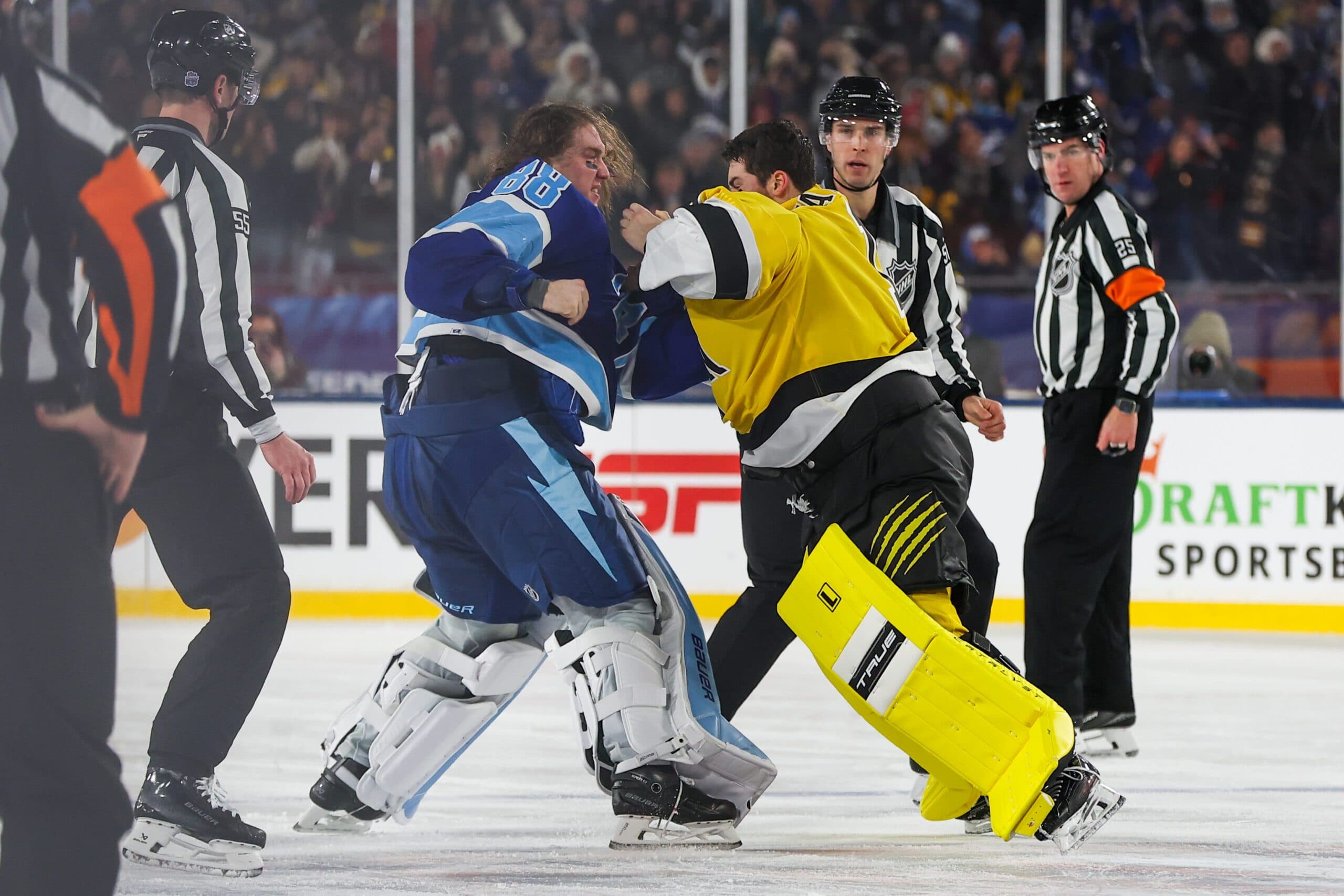
STEVEN ELLIS: I don’t think there is an actual fix for goalie interference unless they take a much harsher stance like in international hockey. What I would do instead is allow goalies to just fight anyone with no consequences. I want to see guys flying up the ice. Just throwing blockers and their sticks at people. It’s always funny when you see a guy run into a goalie because that’s the one position where the guy could hit you with the equivalent of a brick. That’s why I think goalie should have free rein to do whatever they want on the ice. It would be chaotic but hilarious at the same time.
SCOTT MAXWELL: I’m tempted to go with my updated offside rule (which would mean the play isn’t blown dead on offsides, but offside players have to tag up before they can touch the puck), but I don’t think offside is in a place where it needs changing. What needs changing is the puck-over-glass penalty. I understand why the rule was put in place initially, but it has been around long enough that most hockey players no longer instinctively clear pucks to force whistles and line changes. So I think we’re now at the point where it doesn’t need to be punished as severely as an automatic two-minute minor penalty. Instead, just simply treat it to the same standard as icing: if you clear the puck over the glass while in your own zone, a whistle is called, you get a faceoff in your own zone, and no players can change. I think that easily achieves the original purpose of the rule, while also not punishing the countless times it happens accidentally. Seriously, should a player be punished for dumping the puck so hard that it flies up to the netting at the other end of the ice?!? Honestly, it feels like such a layup change to me, I’m shocked it’s never been proposed before.
MIKE GOULD: I’d make it so 3-on-3 overtime is extended to 10 minutes in length during the regular season. It feels like we’ve all collectively moved past the need for shootouts, and even with the more offense-stifling strategy changes that have started to seep into 3-on-3 over the past few years, it’s still one of the most exciting parts of any close hockey game. Also, one of my biggest pet peeves is that players don’t get credit for shootout-winning goals. The fewer of them we see, the better.
ANTHONY TRUDEAU: While I’m surprised no one took the bait and went after the ever-puzzling blood double minor, I’m sticking with my original plan to advocate for game speed replays. The replay system is supposed to weed out “clear and obvious” officiating errors that would otherwise alter the course of a game or series. If Toronto needs to show the zebras frame-by-frame images from several minutes ago to convince them to change a call, were their errors really clear enough to overturn? If officials can only rewatch the action on the ice at the speed at which they originally viewed it, the sort of ties that go the way of the original call will become more commonplace. Coaches’ challenges for razor-thin offside zone entries might go away altogether. Correctness is important, of course, but the NHL is reaching a point where players wait for the replay review first and celebrate second. If you need any evidence of how thoroughly that delay can take the fun out of a moment, check out how VAR is used at soccer’s World Cup in the coming weeks.
_____
POST SPONSORED BY bet365
_____