Is it finally time to trust the Hurricanes in Round 3?

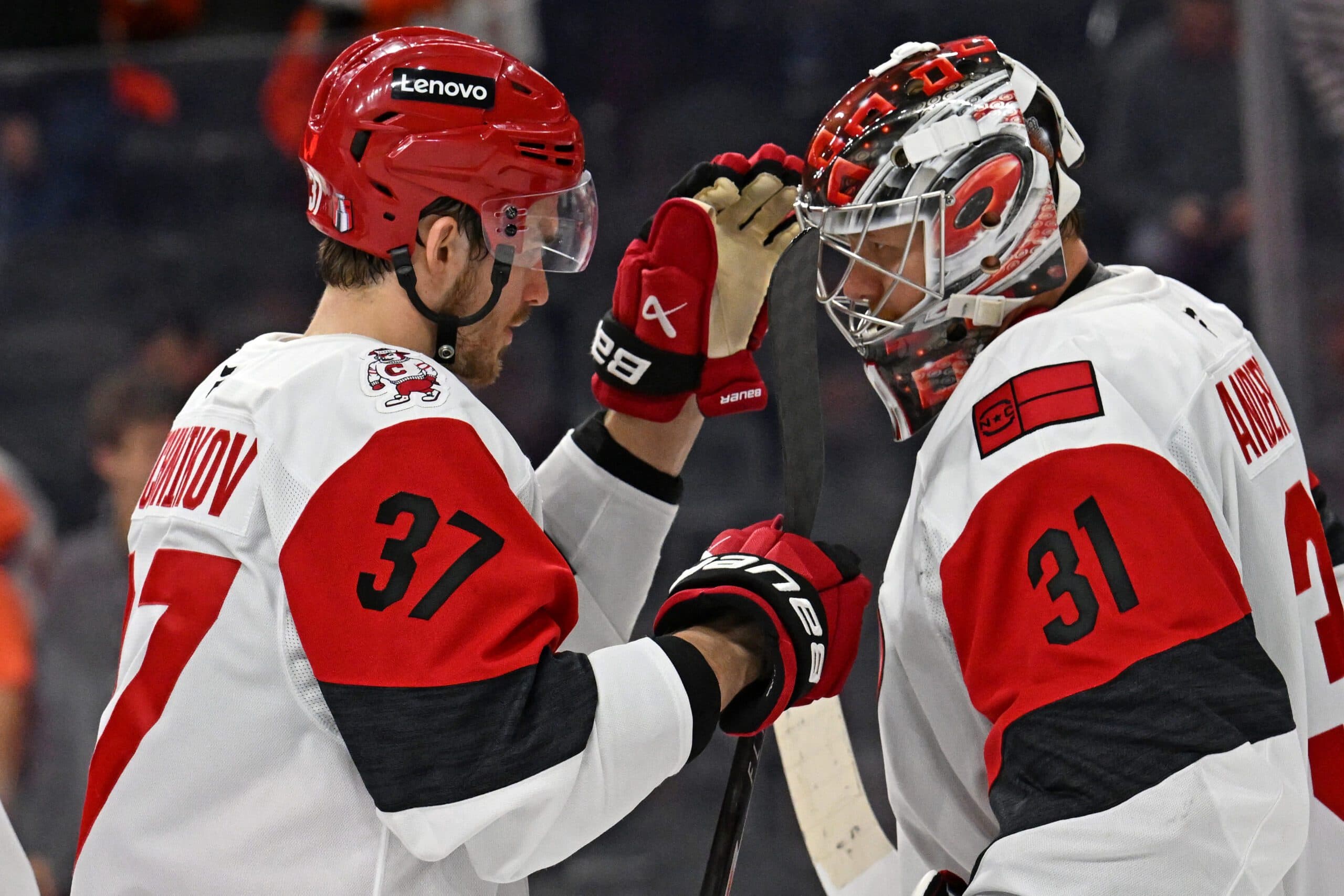
The year is 2025. The Carolina Hurricanes have breezed through the first two rounds of the Stanley Cup playoffs. Frederik Andersen has been historically great in goal. The team finally seems primed to break through and make a Stanley Cup run for the first time in Rod Brind’Amour’s coaching era.
The year is 2026. The Carolina Hurricanes have breezed through the first two rounds of the Stanley Cup playoffs. Frederik Andersen has been historically great in goal. The team finally seems primed to break through and make a Stanley Cup run for the first time in Rod Brind’Amour’s coaching era.
Last season, the Canes went 8-2 in Rounds 1 and 2, tossing aside the New Jersey Devils and Washington Capitals in a pair of gentleman’s sweeps. Andersen went 7-2 with a .937 save percentage across those two series. This season, the Canes are 8-0, having swept the Ottawa Senators and Philadelphia Flyers, becoming the first team this century to run the table across Rounds 1 and 2. Andersen this time: 8-0 with a .950 SV%.
The Canes feel just as invincible now as they seemingly did a year ago, but we all remember what happened. They crashed into the brick wall that was the Florida Panthers. They were pummelled by a combined margin of 16-4 in Games 1-3 to fall behind 3-0 in the series and bowed out in five games. Andersen posted an .838 SV% for the series, and that was with a shutout included.
We can expand the sample size well beyond last season to establish a distrust of Carolina once the playoffs reach the final two rounds. Across Brind’Amour’s eight seasons as bench boss, Carolina has a 55-42 playoff record. That breaks down to a 54-30 record in Rounds 1 and 2 and a 1-12 record in Round 3, with, naturally, a 0-0 record in Round 4, as the Canes haven’t even reached two wins in a Conference Final matchup since 2005-06, when Brind’Amour played for them.
The Canes have steamrolled their opponents so far this spring. They outscored Ottawa and Philadelphia 16-6 at 5-on-5 and generated almost 60 percent of the scoring chances across the two series. The Canes also don’t have to face the wagon that is the back-to-back Cup champion Panthers in the Eastern Conference Final this time around. Are the Canes finally legit? Or are they untested, having walked through a pair of teams who didn’t even occupy playoff spots as recently as April 1?
Let’s see how the 2025-26 Canes compare with the versions that fell short in three Eastern Conference Finals during Brind’Amour’s run as coach – not just in team makeup but, just as importantly, in their path to the reaching the Stanley Cup Final.
PRO: Carolina’s scoring depth is improved
The Hurricanes teams that went 0-8 in the Eastern Conference Final across 2019 and 2023 had no point-per-game playoff scorers and a single player across both runs who even scored goals at north of a 30-goal pace. Last season, Carolina got higher-end contributions from forwards Seth Jarvis, Sebastian Aho and Andrei Svechnikov, but the supporting cast dropped off dramatically after that.
This time around: the Canes have three players averaging a point per game or better so far in the postseason. They have the current playoff goals leader in Logan Stankoven. They have four players with three or more goals through eight games. They’re getting contributions up and down their top-nine forward group, and defenseman K’Andre Miller has chipped in six points of his own through eight games. Carolina controls a league-best 55.47 percent of the scoring chances at 5-on-5 so far in the playoffs. They roll their attacks one aggressive forechecking wave after another and overwhelm their opponents. They’re built to dominate because teams can’t key on a single line against them.
PRO: The Sabres and Canadiens are not the Panthers
The 2022-23 Panthers were an “underdog” team that upset rivals with vastly superior records across Rounds 1 and 2, but Florida had been held back by injuries. It had finished the regular season with the NHL’s sixth-best expected goal differential at 5-on-5, so it was constructed to play strong two-way hockey. The 2024-25 version was similar: Florida ranked among the most elite two-way teams in the league, and the Panthers were also the NHL’s most physical team. Carolina’s fundamental dominance didn’t work against a unit that shared its same strengths plus many others (which we’ll get to later).
The Buffalo Sabres finished this past regular season as a mid-pack team in play driving, and the Montreal Canadiens actually ranked near the bottom of the NHL. Both teams allowed more scoring chances than they generated at 5-on-5 in 2025-26. Whereas the Panthers represented somewhat of a Mirror Match opponent, the Sabres and Habs, for all their strengths, don’t dominate 5-on-5 play the way the Canes do. The expected goal battle last year at 5-on-5 in the series vs. Florida finished 50.73-49.27, more or less a stalemate. This time around, we can expect the Canes to tilt the ice more against Buffalo or Montreal.
CON: Andersen’s history of wilting later in the playoffs
Andersen, 36, has played in and started 93 playoff games, third among active NHL netminders. Among goalies with at least 50 career postseason appearances, he’s 24th all-time in SV% at .916. Huge in the net and steely in his demeanor, he’s been a rock for Carolina so far this postseason; even with elite play in front of him, he’s been arguably the most dominant player in the playoffs, the Conn Smythe Trophy frontrunner.
But Andersen has played 14 games in the Conference Final over the course of his career, during which he’s gone 4-10 with an .894 SV%. As one of the league’s biggest, heaviest goalies, he’s struggled to remain durable, particularly in his mid-30s, and it seems the postseason grind historically wears him down. On the pro side: thanks to the sweep and the NHL’s zany scheduling that had the Canes and Flyers competing in Round 2 before Round 1 was over, Carolina is guaranteed a long break between rounds – a week at minimum, a week and a half if Buffalo and Montreal go to Game 7.
CON: An ice-cold power play
A 13.5 percent conversion rate isn’t just concerning at face value; the Senators and Flyers were two of the league’s worst penalty-killing clubs in the regular season, while Carolina iced a top-four power play. The competition was weak enough that Carolina could get by on its 5-on-5 dominance and elite penalty killing, but this team needs to punish the mistakes better as the degree of difficulty steps up in Round 3.
CON: Sabres, Canadiens share crucial characteristics that have been Carolina kryptonite
Whether it was 2019 or 2023 or 2025, Carolina ultimately bombed for similar reasons each time.
One was star power. In the Canes’ sweep defeat to the Boston Bruins in 2018-19, the Perfection Line of Brad Marchand, Patrice Bergeron and David Pastrnak, all future Hall of Famers, burned them for six goals in four games. It was the Matthew Tkachuk show in 2022-23: he scored four times in five games, including three game winners, two in overtime. Last season, eventual Conn Smythe Trophy winner Sam Bennett ran through the Canes with five goals in five games, while the likes of Tkachuk and another future Hall of Famer, Aleksander Barkov, were major factors.
A hallmark of the Brind’Amour era has been the team-first, rolling-wave mentality, but it doesn’t breed true superstars or the system doesn’t facilitate them (see: Rantanen, Mikko). The Canes haven’t even had a 40-goal scorer since Eric Staal in 2008-09 and have struggled deeper in the playoffs against teams with players capable of taking over games.
Tage Thompson. Rasmus Dahlin. Cole Caufield. Nick Suzuki. Lane Hutson. The Sabres and Habs boast the types of star-grade players that have given Carolina fits in the playoffs.
Three numbers for you: .956, .966, .935. Those are the save percentages Tuukka Rask, Sergei Bobrovsky and again Bobrovsky posted against the Canes in their past three Conference Final defeats. They were goalied hard, which, when combined with their own puck-stopper not being as good on the other end, wrapped up each series quickly. The good news is they won’t be facing a guaranteed Hall of Famer this time, whether it’s Alex Lyon or Jakob Dobes. The bad news is both netminders have been excellent this postseason, posting a SV% of .921 and .918, respectively, and they are younger and fresher than the past-his-prime Andersen. The risk of being goalied again isn’t a zero by any means.
The verdict…?
So will Carolina finally break through with a dominant team and a slightly easier path? It’ll be close. The Sabres and Habs represent steps up in competition from the breezy Round 1 and 2 slate and have some characteristics that should worry Caniacs. But those teams aren’t the perfect winning machines that the Panthers were. No matter what happens, we can expect Carolina to put up a much stronger fight in the Eastern Conference Final this time.
_____
POST SPONSORED BY bet365
_____