The most impactful NHL goalie trades of the salary cap era

Notable goalie trades are rare these days. But that hasn’t always been the case.
This year, we saw the Pittsburgh Penguins and Edmonton Oilers swap Tristan Jarry and Stuart Skinner, with varying degrees of success. The Oilers had previously acquired Connor Ingram from the Utah Mammoth for future considerations, while every other goalie deal this season has been a minor-league move. For the most part, most goalies swap homes in the offseason.
You’ve heard it all before: goaltenders are voodoo. Teams don’t typically like to give away a lot of assets to acquire one, and many are hesitant to spend a lot of money to keep one. A star goalie one year could be AHL-bound the next.
There doesn’t seem to be a cure for that right now. But it’s why we rarely see goalies involved in major trades.
Today, we are going to look at some of the most notable goalie trades of the salary cap era. The salary cap, which was introduced for the 2005-06 season, made moving players a bit more difficult.
But we’ve seen many teams benefit from finding their future No. 1s through trades. From guys needing changes of scenery to others who had just not reached their full potential, here is a look at six of the most notable goaltenders traded over the past 20 years:
2006: Dwayne Roloson to the Edmonton Oilers
Edmonton Oilers acquired: Dwayne Roloson
Minnesota Wild acquired: 2006 first-round pick (Trevor Lewis), conditional 2007 third-round pick (Spencer Machacek)
Every other goaltender on this list won a Stanley Cup at some point, either as a player or an executive. Roloson didn’t, but his play en route to the 2006 Stanley Cup Final is still fondly remembered by Oilers fans around the world. It didn’t start that way, though – GM Kevin Lowe was heavily criticized for not aiming higher on the goalie front as the team looked to make the playoffs. Roloson’s late regular-season play was nothing to get excited about, either – an 8-7-5 record with a .905 save percentage was hardly enough to instil confidence.
But that changed during the postseason. Roloson went 12-5 through the opening three rounds with the No. 8-seeded Oilers, which included some stellar performances against the top seed, Detroit, in the opening round. The Oilers nearly found themselves down 3-0 in their second-round series against the San Jose Sharks. But Roloson was lights out all series long and even shut the Sharks out in the series-clincher later on. Roloson saved some of his best hockey for the Western Conference Final, allowing a goal apiece in three of his four victories.
Suddenly, Roloson’s name popped up as the frontrunner for the Conn Smythe as playoff MVP. And it was hard to argue that – without him, the Oilers would have been out in April. All eyes were on Roloson and his .927 SV% to get the job done against the Hurricanes – only for it all to crumble in Game 1.
Roloson suffered a series-ending knee injury in a collision and was replaced by Ty Conklin. Conklin himself was replaced by Jussi Markkanen for the rest of the series, and while he played well, it wasn’t enough to secure the Cup. Just imagine what could have happened had Rolie the Goalie managed to stay healthy. He never returned to the playoffs with Edmonton, but he nearly mirrored his performance with an outstanding .924 SV% during the 2010-11 postseason. Clearly, mid-season trades worked out for Roloson.
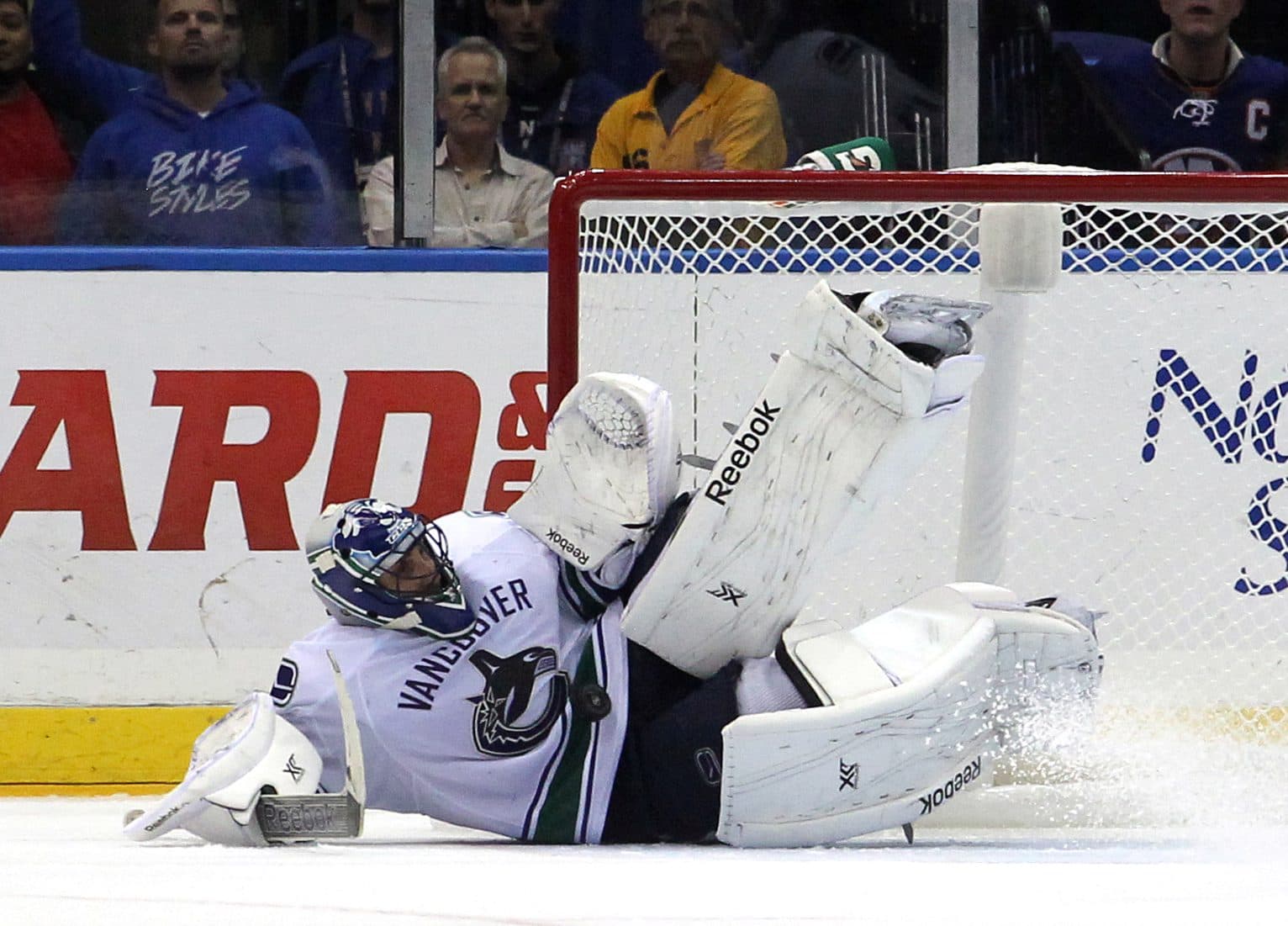
2006: Roberto Luongo to the Vancouver Canucks
Vancouver acquired: Roberto Luongo, Lukas Krajicek, 2006 sixth-round pick (Sergei Shirokov).
Florida acquired: Alex Auld, Bryan Allen, Todd Bertuzzi, conditional 2007 sixth-round pick (not exercised).
Originally a pick of the New York Islanders, Luongo established himself as one of the NHL’s premier young netminders during his initial stint in Florida. The pinnacle of his first Panthers tenure was a 35-win campaign in 2005-06 – the same year he became the franchise’s all-time wins leader. However, following a tense arbitration process and his rejection of a five-year contract offer in January 2006, his name became a fixture of the trade block.
Prior to the start of free agency, GM Mike Keenan sent Luongo to the Canucks in a package deal that sent a trio of veterans the other way. Vancouver signed Luongo to a four-year contract worth $27 million, giving them their first true star goaltender since Kirk McLean left the club nearly a decade prior.
Luongo would go on to post a career-best 47 wins in his first year with the club. He also made the postseason for the first time after years of despair. From there, Luongo would be one of the best goaltenders for a decade, which included helping Canada win gold at the 2010 Olympics. For Vancouver, though, nobody will forget the run that saw him help the team reach Game 7 of the 2011 Stanley Cup Final, only to lose to Boston.
While he never returned to the grand stage with Vancouver – appearing in just 11 playoff games over the following nine seasons – his legacy was far from over. After being traded back to Florida in 2014, he retired in 2019 and eventually secured two Stanley Cups as an executive. Though the Vezina Trophy (surprisingly) eluded him, the two-time all-star’s career was immortalized with an induction into the Hockey Hall of Fame in 2022.
2006: Tuukka Rask to the Boston Bruins
Boston acquired: Tuukka Rask (rights).
Toronto acquired: Andrew Raycroft.
Executed a day after the Luongo trade, this one had lasting effects on both clubs involved. Rask was one of the NHL’s top young goalie prospects, but the Toronto Maple Leafs needed immediate help. They acquired the 2004 Calder Trophy winner, Andrew Raycroft, who’d go on to tie the Leafs’ franchise record for wins in a season in his first campaign. But that was short-lived – he struggled the following season, lost the starting job to Vesa Toskala, and then was bought out before the start of free agency in June of 2008.
Rask, meanwhile, would play his entire 15-year career with the Bruins. He participated in three Stanley Cup Finals (winning 2011 as a backup) and won the 2014 Vezina Trophy. It took Rask a few years to establish himself as an NHL goaltender, and he even shared the crease with Tim Thomas for a time to form one of the best goalie combos in recent memory. Rask would become the starter during the 2012-13 season, and wouldn’t surrender the crease until injuries slowed him down in the 2020s.
Rask finished his career with a record of 308-165-66 while shutting out opponents 52 times. He also had a .921 SV% during the regular season and a .925 during the postseason, which included an insane .940 during the Bruins’ 2013 Cup run. Rask retired as the Bruins’ regular season (308) and playoff (57) wins leader, while his save percentage is one of the best all-time.
2012: Sergei Bobrovsky to the Columbus Blue Jackets
Columbus acquired: Sergei Bobrovsky.
Philadelphia acquired: 2012 second-round pick (Anthony Stolarz), 2012 fourth-round pick (Taylor Leier), 2013 fourth-round pick (eventually traded to Los Angeles; Justin Auger).
Bobrovsky was an undrafted free agent signing by the Philadelphia Flyers in 2010 after four excellent seasons in the KHL. He’d go on to have a strong rookie campaign in 2010-11 before falling flat in 2011-12. In 2012, the club elected to move on after he lost the starter’s gig. Bobrovsky would take over as the starter over Steve Mason, with the Russian keeper taking home his first Vezina Trophy.
From there, Bobrovsky built a reputation as one of the league’s top crease guardians. He’d win gold at the 2014 World Championship while taking home top goalie honors. Bobrovsky won his second Vezina Trophy and was even a Hart Trophy finalist after an outstanding 2016-17 season. His numbers would fall a bit the next two seasons, but he still managed to register nine shutouts during the 2018-19 regular season. Most notably, Bobrovsky led Columbus to a shocking sweep over the first-place Tampa Bay Lightning in the playoffs.
The two sides couldn’t reach a deal from there, and Bobrovsky signed a seven-year, $10 million-per-season deal in 2019. It was one of the most lucrative contracts for a goaltender ever. But it looked like terrible value for a few years. He’d post a 39-7-3 record in 2021-22 but had a SV% of .906 or worse in three of his first four seasons with the club. He even lost the opening-night playoff starting gig to Alex Lyon in 2023.
And then, everything changed. Lyon didn’t turn out to be the answer, with Bobrovsky going 12-6 to help the Cats make the playoffs. Bobrovsky’s stock was never higher than it was in 2024 or 2025, though, helping the Panthers win their first two Stanley Cups. Funny enough, Anthony Stolarz – one of the players chosen with a pick involved in the Blue Jackets deal – was Bobrovsky’s backup on the 2024 Panthers team.
While the biggest moments of Bobrovsky’s career came during his time in Florida, there’s no doubt his regular-season peak came while he was in Columbus. There, he proved he was truly elite – and in line to be a Hockey Hall of Famer one day.
2021: Darcy Kuemper to the Colorado Avalanche
Colorado acquired: Darcy Kuemper.
Arizona acquired: Conor Timmins, 2022 first-round pick (traded to Edmonton; Reid Schaefer), conditional 2024 third-round pick (Tomas Lavoie).
You could argue Kuemper is in his prime now – he was a Vezina Trophy winner a year ago and was good enough to become one of Canada’s Olympic goalies this year. But Kuemper’s career will always be defined by his one-and-done year in Colorado. He had some solid moments as Arizona’s starter for a few years, and while he could be streaky, the highs often outweighed the lows.
But Colorado needed to shore up their goaltending for 2021-22 after losing Philipp Grubauer to the expansion Seattle Kraken. Many expected the team to go deep, but they needed a true No. 1 goaltender to bring them there. That turned out to be Kuemper, who set a career-high with 37 wins while tying his previous best of five shutouts. His .921 SV% was among the best in the league, and most expected the Avs to be a serious contender when it mattered with him in net.
On the surface, Kuemper got the job done with 10 wins in 16 games. But he often struggled to look like a true high-end keeper, and suffered with eye issues that forced him to work with a vision specialist to “re-train his eye”. Kuemper held his own during the Final, beating the Tampa Bay Lightning for the title. He bolted to Washington during the offseason before landing in Los Angeles in 2024, where he remains to this day.
2022: Adin Hill to the Vegas Golden Knights
Vegas acquired: Adin Hill.
San Jose acquired: 2024 fourth-round pick (Christian Kirsch).
Arizona Coyotes fans believed in Hill, but things just never seemed to come to fruition. He was flipped to the San Jose Sharks in 2021-22, where he played some solid hockey in his best season to date. But Hill didn’t appear to be the answer for the Sharks in the long term, especially with Kaapo Kahkonen looking to secure the backup job following a solid stint as a rookie.
So the Sharks flipped Hill to the Golden Knights, with San Jose then selecting goaltender Christian Kirsch two years later. Kirsch has some long-term backup potential for the Sharks, so we’ll see if it pays off. But the low-risk, high-reward move proved fruitful for the Golden Knights, even as injuries wreaked havoc on the team’s crease. Robin Lehner missed the entire season, while Laurent Brossoit missed the first few months himself. That left the crease to a pair of unproven youngsters – Hill and Logan Thompson.
Hill played quite well that season, going 16-7-1. That didn’t stop Vegas from changing things up in net, though. Brossoit started as the playoff No. 1. They also acquired Jonathan Quick as insurance while Thompson was injured. By all accounts, it felt like we wouldn’t see Hill in that playoff run. Instead, he finished third in Conn Smythe voting as playoff MVP after going 11-4 with an incredible .932 SV%, helping the Golden Knights win their first Stanley Cup.
Injuries have caused Hill some issues the past few seasons, and his inconsistent play prevented him from making Canada’s Olympic team after he served as a backup at the 4 Nations Face-Off. Hill’s regular-season numbers have never been that special. But he has proven he can win big games. The Golden Knights will be forever thankful for that.
TRADE DEADLINE SPECIAL

The 2026 Trade Deadline Special is going LIVE March 6th. Join the Daily Faceoff crew on Friday, March 6th, from 11 AM-3:30 PM ET for wall-to-wall coverage of every single move as it happens. Get instant reaction, expert analysis, and exclusive insights from special guests throughout the day. Tune in LIVE on the Daily Faceoff YouTube channel and don’t miss a second of deadline day chaos.
_____